
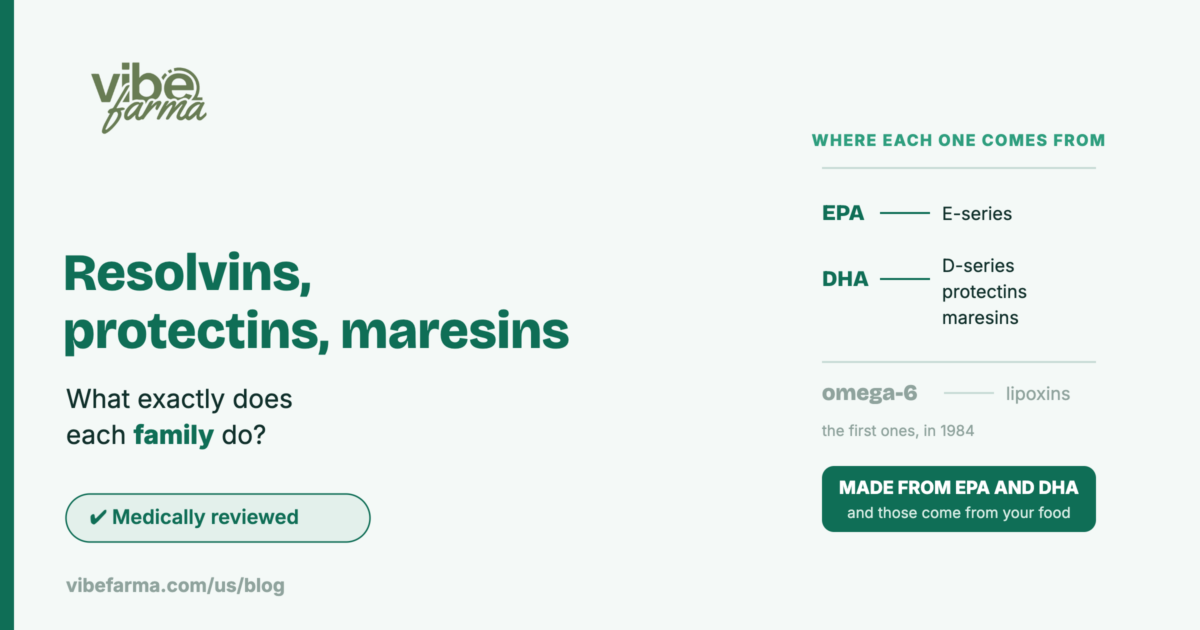
The short version: these are molecules your body makes from the fatty acids in its own cell membranes, and their job isn’t to switch inflammation off but to direct how it wraps up. They’re grouped into families by the fatty acid they come from: the E-series comes from EPA; the D-series, protectins and maresins come from DHA; and lipoxins, the first ones discovered, back in 1984, come from omega-6. What they do isn’t a milder version of an anti-inflammatory: it’s a different verb. They stop more cells from arriving and boost the macrophage’s ability to clear out the spent ones, and that has been measured in human cells, molecule by molecule. The third step, carrying the debris away through the lymphatic system, has so far been measured in animals.
Contenido
Why did the first one come from omega-6?
Because the story doesn’t start with fish: it starts in 1984, with arachidonic acid. That year, a team at the Karolinska Institute described a new chemical family formed in human white blood cells from arachidonic acid, an omega-6. They called them lipoxins1.
The paper came out of the lab of Bengt Samuelsson, who won the Nobel Prize in Medicine in 1982 for his work on prostaglandins. Its first author, Charles Serhan, who would later name the resolvins, was his postdoctoral researcher at the time.
No need to dress it up: in that paper, lipoxins were not described as anti-inflammatory. Quite the opposite: one of them stimulated neutrophils about as strongly as a clearly inflammatory mediator. It took years to understand that this was a signal to close.
The detail matters for another reason. If the first pro-resolving molecule ever described comes from omega-6, then the “omega-6 bad, omega-3 good” story is too simple to be true. What there is isn’t a good side and a bad side: it’s a sequence.
What are they, in one sentence?
They’re lipid mediators your body makes on demand from the fatty acids in its membranes, and they take part in the closing phase of an inflammatory response. In the research they’re called specialized pro-resolving mediators, and that’s where the acronym SPM comes from.
They aren’t stored. They’re made on the spot, they don’t last long, and they act close to where they were made. And each family has its own raw material, its own enzyme and its own cell:
| Family | Comes from | Fatty acid | Key enzyme | Made by |
|---|---|---|---|---|
| Lipoxins | arachidonic acid | omega-6 | 5-LO together with 15-LO | human white blood cells |
| E-series (E resolvins) | 18-HEPE | EPA (omega-3) | 5-LO, and 12/15-LO for E3 | neutrophil and eosinophil |
| D-series (D resolvins) | 17-HDHA | DHA (omega-3) | 15-LO plus 5-LO | neutrophil |
| Protectin D1 | 17-HpDHA | DHA | 15-LO, via an epoxide | neutrophil; called neuroprotectin D1 in nerve tissue |
| Maresin 1 | 14-HpDHA | DHA | macrophage 12-LO | macrophage |
Look at the last column, because it’s the part almost nobody mentions: no gland makes them. They’re made by the very cells that showed up to the inflammatory response, and each cell type makes its own.
Which ones come from EPA?
The E-series resolvins come from EPA.
The first one described was resolvin E1, and it brought with it the detail that says most about the whole family: it has its own receptor2. A molecule with a receptor means the body was expecting it. It doesn’t work by sheer amount, like adding more salt: it works like a key in a lock.
Resolvin E3 came later, with a twist3: a different cell makes it. Not the neutrophil but the eosinophil, and with a different enzyme. The same raw material yields different products depending on who’s working it.
Which ones come from DHA?
DHA feeds three families, and what sets them apart is which enzyme gets there first.
The word “resolvin” was coined in 2002, for omega-3 products that counter switch-on signals4. The whole family grows from there.
Protectins came soon after145, and their name trips a lot of people up: the same molecule is called protectin D1 in general and neuroprotectin D1 when it shows up in nerve tissue. They aren’t two things. It’s one molecule with two names, depending on where it is.
Maresins were the last to arrive, in 2009, and they’re the macrophage’s work6; hence the name, macrophage mediator in resolving inflammation. Maresin 1 does something worth understanding well: at tiny concentrations it pushes human macrophages to clear out spent neutrophils, a bit more strongly than resolvin D17. The inflammatory mediator it was compared with doesn’t do that.
What do they do that an anti-inflammatory doesn’t?
They resolve instead of blocking. Those aren’t two strengths of the same thing: they’re two different verbs.
An anti-inflammatory cuts production of the mediators that switch things on. These molecules do something else, and it comes down to three concrete actions:
- They stop more cells from arriving. Resolvin D1 halts the migration of human neutrophils at tiny concentrations13, protectin D1 dampens it5, and lipoxin A4 flat-out “stopped” the influx8. Three molecules from three different families, all in human cells, all doing the same thing.
- They speed up the removal of spent cells. The macrophage eats the neutrophils that have done their job. That process is called efferocytosis, and it’s the step that really closes things.
- They carry the debris out through the lymphatic system. The clean-up doesn’t stay in the tissue: it gets hauled away. This, so far, has been measured in animals.
What happens when they’re missing?
The cleanest demonstration there is appeared in Nature, and it’s in mice9. Researchers blocked the enzymes that make both the switch-on mediators and the closing ones. The result: the inflammation didn’t resolve. The authors called it by its name: a resolution deficit.
Then they did what you have to do to find out who was responsible: they added back resolvin E1 and protectin D1. The gap closed.
Blocking the enzyme doesn’t only remove the switch-on mediators: it leaves resolution without the material it works with. It’s mice, so nobody’s saying this happens to you. But it’s the same mechanism described, from another lab and another model, in the resolution window.
And there’s a second piece, this time in people. When a small, controlled inflammation is triggered in the skin of younger and older volunteers, the switch-on is the same in both groups: what’s impaired in the older group is the shutdown, because their macrophages clear dead cells less well. The full story is in why your body can’t make the omega-3 it needs.
Switching on and closing are two separate abilities. They wear down separately, and the one that wears down is the second.
What has been measured in people?
When a person takes EPA or DHA, the precursors of these molecules rise in their blood, and they rise more the more they take.
That part is well established. With placebo, nothing moves; with EPA, 18-HEPE, the precursor of the E-series, goes up, and the difference shows between week four and week twelve10. This is a matter of weeks, not days.
And it doesn’t stop at a blood test. With a marine oil rich in those precursors, white blood cells got better at capturing bacteria, and within 24 hours the expression of their immune genes had changed11. Substrate, signal and function, measured in people.
One thing to keep straight: a precursor isn’t the same as a finished mediator. The finished mediators rise much less, and unevenly: in the EPA study above, one resolvin only appeared after supplementing and another wasn’t detected at all. And the response isn’t the same in everyone: among older adults, men and women responded differently12.
Where does your body get the raw material?
From food. The three omega-3 families in this article are made from EPA and DHA, and your body doesn’t produce either one in meaningful amounts.
That’s the sentence that links the biochemistry to your plate. Without raw material, there’s nothing to make the closing signal from, and the placebo-controlled study in the section above showed that the material does arrive once you take it in.
That’s the whole case for the substrate: EPA and DHA from oily fish or a marine oil support your body’s own resolution process and a healthy inflammatory response.* If you want the entry-level version, without the biochemistry, it’s in what SPMs are; and the process these molecules direct, step by step, is in what resolution of inflammation is.
Frequently asked questions
What are resolvins, protectins and maresins?
They’re lipid mediators your body makes from the fatty acids in its cell membranes, and they take part in the closing phase of an inflammatory response. E-series resolvins come from EPA; D-series resolvins, protectins and maresins come from DHA. They aren’t stored: they’re made on the spot and don’t last long.
How are they different from an anti-inflammatory?
An anti-inflammatory cuts production of the mediators that switch inflammation on. What has been described for these molecules is different: they stop more cells from arriving, boost the macrophage’s ability to clear out spent cells, and help carry debris away through the lymphatic system. It isn’t a milder version of the first.
Which fatty acid does each family come from?
Lipoxins come from arachidonic acid, an omega-6. E-series resolvins come from EPA. D-series resolvins, protectins and maresins come from DHA. The last three are omega-3.
Does taking omega-3 raise resolvins in the blood?
What reliably rises, and more with larger amounts, are the precursors: 18-HEPE and 17-HDHA. The finished mediators rise much less, and unevenly: in one EPA study, one resolvin only appeared after supplementing and another wasn’t detected at all.
Who discovered SPMs?
The starting point is the lipoxins, described in 1984 in the lab of Bengt Samuelsson, winner of the 1982 Nobel Prize in Medicine. Resolvins were named in 2002 in work by Charles Serhan and his team; Serhan had been Samuelsson’s postdoc. Maresins arrived in 2009.
Has it been shown that they regenerate tissue?
In people, evidence of structural repair, tissue that rebuilds and can be seen, isn’t there. What exists is evidence in animal models and in cell culture. Carrying that over to a person would mean making up the result.
What is efferocytosis?
It’s the process by which macrophages remove neutrophils that have done their job and entered programmed cell death. It’s one of the steps in closing an inflammatory response, and one of the actions described for these molecules in human cells.
References
- Serhan CN, Hamberg M, Samuelsson B. Lipoxins: novel series of biologically active compounds formed from arachidonic acid in human leukocytes. PNAS, 1984;81(17):5335-9.
- Arita M, Bianchini F, Aliberti J, et al. Stereochemical assignment, antiinflammatory properties, and receptor for the omega-3 lipid mediator resolvin E1. J Exp Med, 2005;201(5):713-22.
- Isobe Y, Arita M, Matsueda S, et al. Identification and structure determination of novel anti-inflammatory mediator resolvin E3, 17,18-dihydroxyeicosapentaenoic acid. J Biol Chem, 2012;287(13):10525-34.
- Serhan CN, Hong S, Gronert K, et al. Resolvins: a family of bioactive products of omega-3 fatty acid transformation circuits initiated by aspirin treatment that counter proinflammation signals. J Exp Med, 2002;196(8):1025-37.
- Serhan CN, Gotlinger K, Hong S, et al. Anti-inflammatory actions of neuroprotectin D1/protectin D1 and its natural stereoisomers: assignments of dihydroxy-containing docosatrienes. J Immunol, 2006;176(3):1848-59.
- Serhan CN, Yang R, Martinod K, et al. Maresins: novel macrophage mediators with potent antiinflammatory and proresolving actions. J Exp Med, 2009;206(1):15-23.
- Serhan CN, Dalli J, Karamnov S, et al. Macrophage proresolving mediator maresin 1 stimulates tissue regeneration […]. FASEB J, 2012;26(4):1755-65.
- Levy BD, Clish CB, Schmidt B, Gronert K, Serhan CN. Lipid mediator class switching during acute inflammation: signals in resolution. Nat Immunol, 2001;2(7):612-9.
- Schwab JM, Chiang N, Arita M, Serhan CN. Resolvin E1 and protectin D1 activate inflammation-resolution programmes. Nature, 2007;447(7146):869-74.
- Lamon-Fava S, So J, Mischoulon D, et al. Dose- and time-dependent increase in circulating anti-inflammatory and pro-resolving lipid mediators following eicosapentaenoic acid supplementation. Prostaglandins Leukot Essent Fatty Acids, 2021;164:102219.
- Souza PR, Marques RM, Gomez EA, et al. Enriched marine oil supplements increase peripheral blood specialized pro-resolving mediators concentrations and reprogram host immune responses. Circulation Research, 2020;126(1):75-90.
- So J, Yao JH, Magadmi R, Matthan NR, Lamon-Fava S. Sex differences in lipid mediators derived from omega-3 fatty acids in older individuals […]. Prostaglandins Leukot Essent Fatty Acids, 2024;203:102655.
- Sun YP, Oh SF, Uddin J, et al. Resolvin D1 and its aspirin-triggered 17R epimer. Stereochemical assignments, anti-inflammatory properties, and enzymatic inactivation. J Biol Chem, 2007;282(13):9323-34.
- Hong S, Gronert K, Devchand PR, Moussignac RL, Serhan CN. Novel docosatrienes and 17S-resolvins generated from docosahexaenoic acid in murine brain, human blood, and glial cells. Autacoids in anti-inflammation. J Biol Chem, 2003;278(17):14677-87.
✔️ Medical review
This article was reviewed by Dr. Jorge Oseguera Anguiano, a physician specializing in functional and pro-resolution medicine, to verify the accuracy of its content.
* These statements have not been evaluated by the Food and Drug Administration. These products are not intended to diagnose, treat, cure, or prevent any disease.

Toni Villar
Founder of Vibefarma. Sixteen years studying the resolution of inflammation — first as a health educator, then alongside the physicians who apply it in clinic. That path led to a meeting with Dr. Charles Serhan at Harvard Medical School, the researcher who discovered SPMs.
He writes here about what the science actually says, with the sources in plain sight. Every article is medically reviewed before it goes out. More about Vibefarma →
Other articles you might find interesting
Resolution of inflammation
How long your body takes to recover from summer
Resolution of inflammation
Resolvins, protectins and maresins: what each one does
Resolution of inflammation
What Is Resolution of Inflammation? The Program Your Body Already Has