
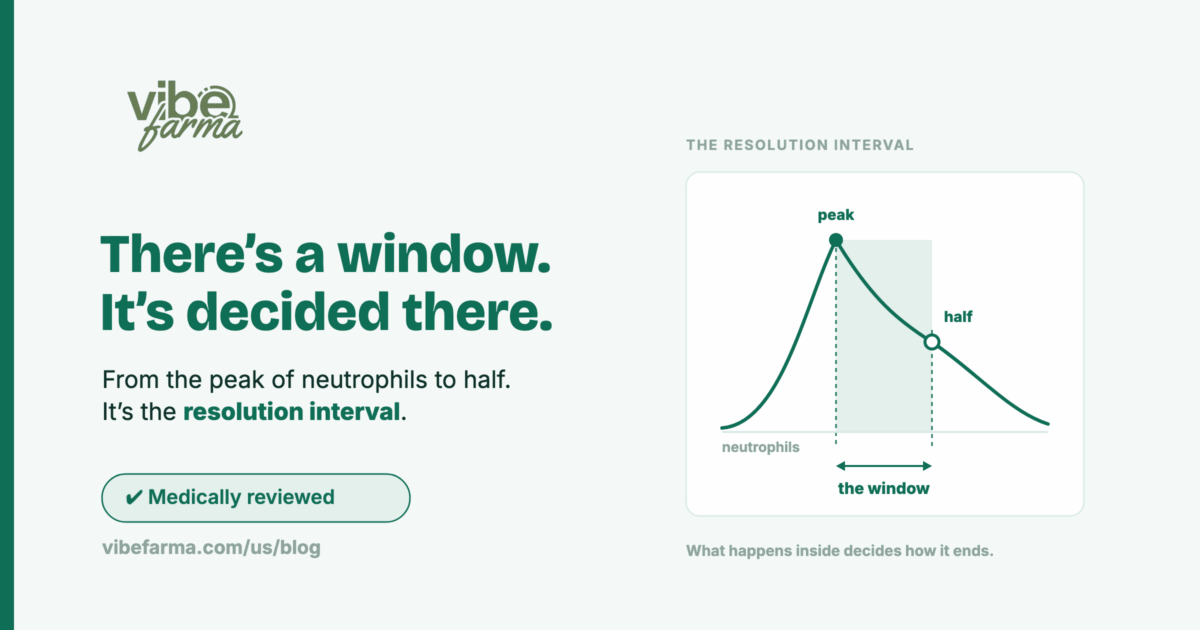
The short version: lowering inflammation and resolving it are not the same thing. Your body runs a program to close it, and that program runs inside a window you can actually measure: from the peak of immune cells until they fall to half. It is called the resolution interval. Inside that window something happens that almost nobody expects — the same pathway that switched inflammation on is the one that gives the order to shut it down. And there are placebo-controlled human trials measuring both steps: omega-3 raises the precursors of those shut-down signals, and an oil rich in those precursors raises the signals themselves and changes what your immune cells do.
Contenido
Almost everyone assumes the same thing
That inflammation ends when the reason for it goes away. That it burns itself out, like a fire running out of wood.
It doesn’t. It gets closed. And closing it is work.
In 2005, Charles Serhan and John Savill published a paper in Nature Immunology whose title said it all: Resolution of inflammation: the beginning programs the end1. What they describe is an active, coordinated program that starts in the first few hours, not at the end. The cells that showed up to defend the tissue flip a switch: the molecules that were amplifying the process give way to others that start the termination sequence. Recruitment stops, the cells that came in stand down, macrophages clear the debris, the tissue is repaired, and the cleanup crew clears out through the lymphatic vessels.
That is resolution. Not inflammation going down — inflammation being closed and repaired. We cover it in full in what resolution of inflammation is.
That window has a name and a number
The resolution interval is the time from the peak of neutrophils in an inflammatory response until those cells fall to half that number. And you can put a figure on it.
Bannenberg, Serhan and colleagues measured the process in 2005, in murine exudates, and put numbers on it2. Three of them, and they are simple:
The peak. The highest number of neutrophils — the first cells to arrive — across the whole response.
The time. When that peak is reached.
The resolution interval. The time from the peak until those cells drop to half.
That interval is the window. What happens inside it decides how the story ends.
And it is not a window where you wait for something to pass. It is when the body is doing the work.
What happens inside: the class switch
Inside that window, the molecules that were amplifying inflammation give way to molecules that order it closed. It is called lipid mediator class switching, and it is the most counterintuitive part of all this.
In 2001, in the same lab, Bruce Levy and Serhan described the switch3. And the key piece was not seen in a mouse: they exposed human peripheral blood neutrophils to prostaglandin E2 — one of the molecules that amplify inflammation, from the family the COX enzymes produce — and those cells changed what they were making: they stopped producing leukotriene B4 and started producing lipoxin A4, a molecule that, in their words, “stopped” the infiltration.
Read that again. The molecule that switches inflammation on is the one that later gives the order to start shutting it down.
The authors put it plainly: first-phase mediators promote the shift toward anti-inflammatory lipids. There are not two opposing camps. There is a sequence, and each piece calls the next one. The molecules that run that shutdown are the ones we explain in what SPMs are.
The clock experiment
The same anti-inflammatory, given at two different points in an inflammatory response, produced opposite results. If the same pathway switches inflammation on and then orders it closed, there is an uncomfortable question: what happens if you block it right when it is time to close?
Derek Gilroy and his team measured it, and Nature Medicine published it in 19994.
The clock experiment cannot be run in people — nobody is going to block your resolution to see what happens — so it was run in animals — carrageenin-induced pleurisy in rats. They found that COX-2, the main target of common anti-inflammatories, does not appear once but twice. A first peak early on, as inflammation starts. And two days later, a second peak 350% larger than the first — exactly as the process was resolving.
Then they blocked the enzyme at each point. At two hours, the anti-inflammatory did its job: inflammation went down. At forty-eight hours, the same substance made it significantly worse.
And here is a detail that makes this more interesting, not less: in the late phase the enzyme is not making the same thing it made at the start. In this experiment PGE2 synthesis was minimal at forty-eight hours, and what had risen were other prostaglandins from the same family. When they put exactly those back, the effect reversed.
The pathway is the same. The specific messenger changes with the tissue and the moment. And it was not noise: it was the shut-down signal, removed at the point where it was needed.
Same drug. Two different points in time. Opposite results.
And not only in acute inflammation
In a chronic model the same thing happened: blocking the pathway during the resolution phase perpetuated inflammation instead of easing it.
Marion Chan and Andrea Moore took the question to a chronic model — arthritis in mice — and published the result in 2010 in the Journal of Immunology5. And when they put back the molecule they had removed, things went back to normal, again through lipoxin.
Their conclusion contains the most honest line in all of this, and it is their name on it: this might explain why COX-2 inhibitors are palliative rather than curative, because blocking resolution may mitigate the benefit of having prevented the onset.
That is not a supplement brand talking. That is an immunology journal.
Aspirin is the exception, and it explains everything
Aspirin does not leave the enzyme inert: it modifies it, and the modified enzyme makes molecules that push toward resolution. This is where the piece stops looking like a crusade against anti-inflammatories, because it isn’t one.
Aspirin also shuts down normal prostaglandin production — that is what acetylating the enzyme does, and it does it permanently6. But modifying it does not leave it inert: the acetylated enzyme starts making something else, which another cell converts into molecules related to the lipoxins, the ones that push toward resolution.
It blocks, yes. But it also opens a way out. And that is the real difference — not between taking something and taking nothing.
To be clear about what this is not: it is not advice to swap an anti-inflammatory for aspirin. Aspirin carries its own risks and a physician decides when it is appropriate. It is here to explain a mechanism, not to pick a pill.
Has any of this been measured in people?
Yes: placebo-controlled human trials have measured how the shut-down signals rise in blood after supplementation. And this is the part I find most interesting.
In late 2019, a team at Queen Mary University of London published a randomized, double-blind, crossover, placebo-controlled trial in 22 healthy volunteers in Circulation Research7. They gave them a single administration of a marine oil enriched in those precursors, at three different dose levels, and measured what happened in their blood at 2, 4, 6 and 24 hours.
The shut-down signals rose with dose and with time. But the study did not stop at the readout: those participants’ neutrophils and monocytes cleared bacteria more effectively, there was less diurnal leukocyte and platelet activation, and by twenty-four hours the expression of immune and metabolic genes had changed.
It is a small, exploratory trial, and that is worth saying. Its value lies elsewhere: it has a placebo arm, and it did not stop at measuring molecules — it measured whether the cells behaved differently.
And there is a second trial covering the upstream step8. Twelve weeks, EPA on its own at different doses, in people carrying low-grade chronic inflammation alongside depression: the precursor of one of those signals rose more the higher the dose, and one of the resolvins did not appear at all until supplementation began. With placebo, nothing moved.
Together they cover the whole chain, each covering its own stretch: the fatty acid raises the precursor, and the oil rich in precursors raises the signal and changes what the cell does.
Your body makes its own shut-down signals, and it makes them from EPA and DHA9. And EPA and DHA are essential fatty acids in the sense that matters: your body can make them from a plant-derived omega-3, but so poorly — only a tiny fraction ever reaches DHA — that in practice you depend on what you eat.
Without that raw material, the factory has the blueprint but nothing to build with.
It is the same idea as always, only now with a stopwatch in front of it and a trial behind it: omega-3 is not an anti-inflammatory. It is the substrate your body uses to build its own resolution signals — it supports the body’s normal resolution process.
What this does NOT mean
Worth saying in the same plain words as everything else.
There is no clinical trial showing that taking an anti-inflammatory makes your inflammation chronic. There isn’t one, and we are not going to imply there is. What exists is a described and measured mechanism that raises a fair question about when — not about whether.
And no dosing guidance follows from it either: nobody has tested in people whether changing the timing of a dose changes the outcome.
These statements have not been evaluated by the Food and Drug Administration. This content is for educational purposes and is not intended to diagnose, treat, cure, or prevent any disease.
Anti-inflammatories exist because they work, and millions of people need them.
What you can actually do with this
Take it to your doctor and talk it through.
And look at the dates on everything you have just read: 1999, 2001, 2005, 2010. Resolution as an active program, with its phases and its timings, was described after the textbooks that trained much of the profession were written. Nobody got it wrong. This simply arrived later.
So you are not going to tell anyone to stop anything. You are going to start a conversation, and you are not walking in with what a brand says — you are walking in with the profession’s own literature, published, with named authors and a DOI.
The beginning programs the end. And in between, there is a window.
Frequently asked questions
What is the resolution interval?
It is the time from the peak of neutrophils in an inflammatory response until those cells fall to half that number. It was defined in 2005 along with two other indices — the peak itself and the time at which it occurs — in work measuring exudates in mice. It is the window in which the body carries out the shutdown.
Is lowering inflammation the same as resolving it?
No. Lowering inflammation means reducing its intensity. Resolving it is an active program with phases: recruitment stops, the cells that arrived stand down, macrophages clear the debris, and the tissue is repaired. Inflammation can be low and still not be closed.
Do anti-inflammatories stop inflammation from closing?
No clinical trial has shown that in people. What exists are animal experiments in which blocking the COX enzyme in the late phase made inflammation worse instead of better, while blocking it early did reduce it. It is a question about timing, not about the drug.
Why is aspirin different from other anti-inflammatories?
Aspirin acetylates the COX-2 enzyme rather than leaving it inert. It still shuts down normal prostaglandin production, but the modified enzyme starts making a different product that another cell converts into molecules related to the lipoxins, the ones that push toward resolution. It blocks, and it also opens a way out.
What role does omega-3 play in the resolution of inflammation?
The body builds the signals that close inflammation — resolvins, protectins and maresins — from EPA and DHA. The body makes them from a plant-derived omega-3, but so inefficiently that in practice they depend on the diet. In placebo-controlled trials, supplementation raises the blood levels of the precursors of those signals.
Should I change when I take my anti-inflammatory?
Not on the basis of this article. Nobody has tested in people whether changing the timing of a dose changes the outcome, so no guidance follows from it. If the topic interests you, that conversation belongs with your doctor.
References
- Serhan CN, Savill J. Resolution of inflammation: the beginning programs the end. Nature Immunology, 2005;6(12):1191-7.
- Bannenberg GL, Chiang N, Ariel A, et al. Molecular circuits of resolution: formation and actions of resolvins and protectins. Journal of Immunology, 2005;174(7):4345-55.
- Levy BD, Clish CB, Schmidt B, Gronert K, Serhan CN. Lipid mediator class switching during acute inflammation: signals in resolution. Nature Immunology, 2001;2(7):612-9.
- Gilroy DW, Colville-Nash PR, Willis D, et al. Inducible cyclooxygenase may have anti-inflammatory properties. Nature Medicine, 1999;5(6):698-701.
- Chan MM, Moore AR. Resolution of inflammation in murine autoimmune arthritis is disrupted by cyclooxygenase-2 inhibition and restored by prostaglandin E2-mediated lipoxin A4 production. Journal of Immunology, 2010;184(11):6418-26.
- Morris T, Stables M, Gilroy DW. New perspectives on aspirin and the endogenous control of acute inflammatory resolution. TheScientificWorldJournal, 2006;6:1048-65.
- Souza PR, Marques RM, Gomez EA, et al. Enriched marine oil supplements increase peripheral blood specialized pro-resolving mediators concentrations and reprogram host immune responses. Circulation Research, 2020;126(1):75-90.
- Lamon-Fava S, So J, Mischoulon D, et al. Dose- and time-dependent increase in circulating anti-inflammatory and pro-resolving lipid mediators following eicosapentaenoic acid supplementation in patients with major depressive disorder and chronic inflammation. Prostaglandins, Leukotrienes and Essential Fatty Acids, 2020;164:102219.
- Serhan CN, Chiang N, Dalli J, Levy BD. Lipid mediators in the resolution of inflammation. Cold Spring Harbor Perspectives in Biology, 2014;7(2):a016311.
✔️ Medical review
This article was reviewed by Dr. Jorge Oseguera Anguiano, a physician specializing in functional and pro-resolution medicine, to verify the accuracy of its content.
* These statements have not been evaluated by the Food and Drug Administration. These products are not intended to diagnose, treat, cure, or prevent any disease.
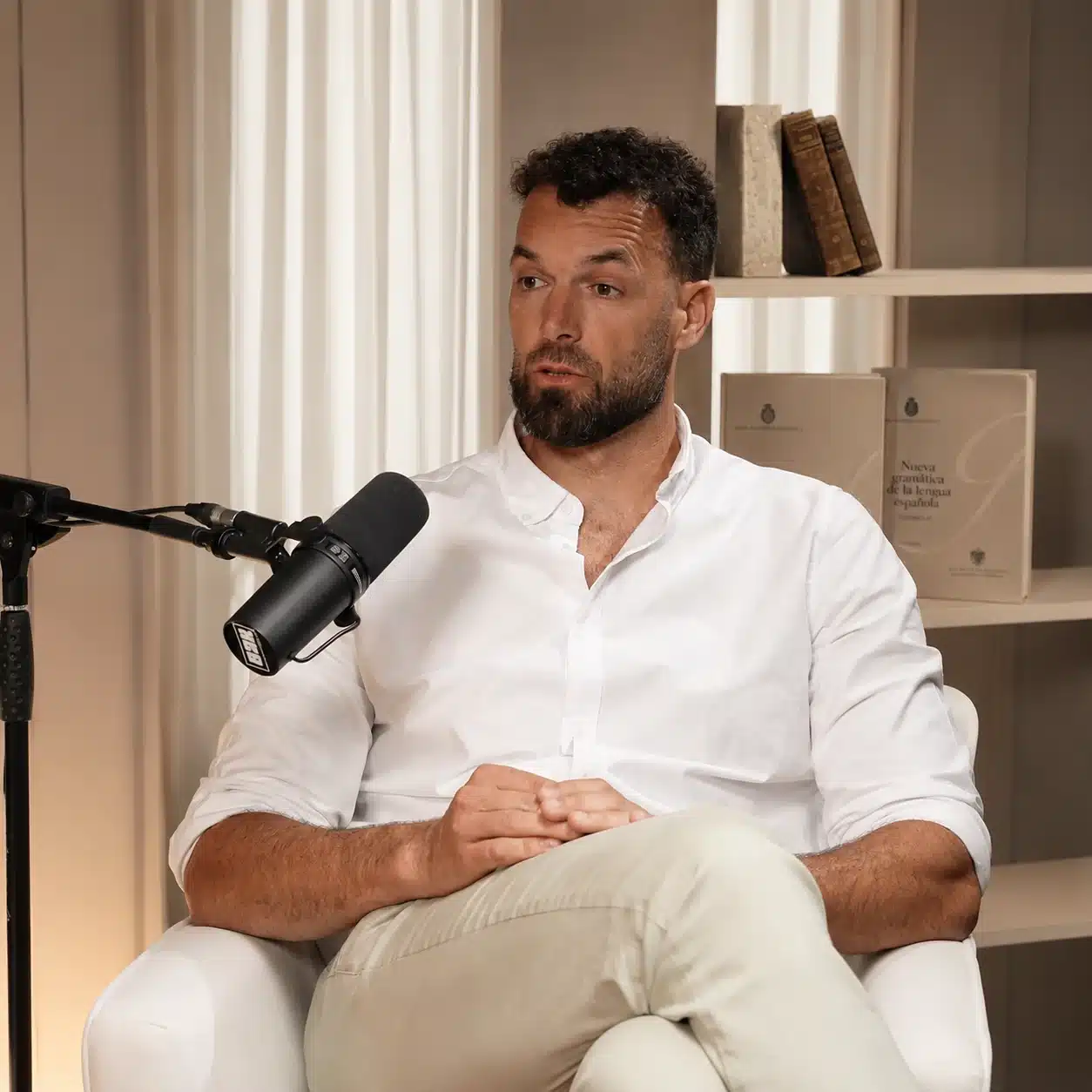
Toni Villar
Founder of Vibefarma. Sixteen years studying the resolution of inflammation — first as a health educator, then alongside the physicians who apply it in clinic. That path led to a meeting with Dr. Charles Serhan at Harvard Medical School, the researcher who discovered SPMs.
He writes here about what the science actually says, with the sources in plain sight. Every article is medically reviewed before it goes out. More about Vibefarma →
Other articles you might find interesting
Resolution of inflammation
What Is Resolution of Inflammation? The Program Your Body Already Has
Resolution of inflammation
What Are SPMs and How They Resolve Inflammation
Resolution of inflammation
The resolution interval: the window where it gets decided