
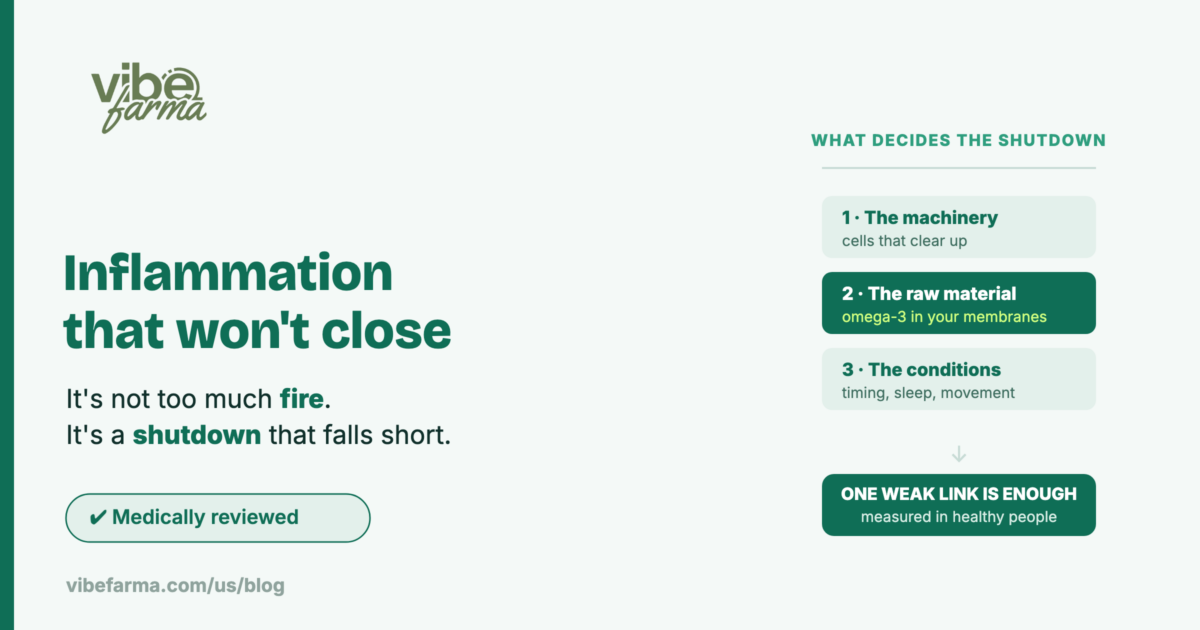
The short version: inflammation that lingers usually isn’t inflammation that’s too strong. It’s a shutdown that falls short. Your body doesn’t turn inflammation off by waiting for it to burn out: it closes it with a program of its own, and that program can stall halfway. A London lab has timed it in healthy people, by triggering a small, controlled inflammation in the skin: faced with the same trigger, some people close it early and others late, and with age the switch-on stays the same while the shutdown gets slower. Three things decide the shutdown: the machinery that clears up, the raw material your body builds its resolution signals from —omega-3— and the conditions you live in. Looking after all three adds a layer to whatever you’re already doing: helping your body finish what it started.
Contenido
Is inflammation that won’t go away just “too strong”?
Not necessarily. What won’t go away is what hasn’t been closed, and that’s a different thing.
Intuition says that if something is still inflamed, there must be a lot of fire. Carl Nathan and Aihao Ding put it another way in Cell: apart from whatever triggered it still being there, inflammation stays unresolved when the mechanisms that should close it fall short. And that can happen whether the response starts off excessive or starts off weaker than normal1.
In healthy volunteers, the people who became most inflamed at the start were the ones who cleared their inflammatory cells fastest at the end2. Switching on hard wasn’t the problem. For them, it was part of closing well.
If you want the closing process step by step, it’s in what resolution of inflammation is. Here we go to what goes wrong.
Can you actually see whether someone’s body closes inflammation well?
Yes. The shutdown of an inflammatory response can be timed in people, and not everyone closes it the same way.
There are lab models built precisely for that: in healthy volunteers, a small, controlled inflammation is triggered in the skin of the forearm —a tiny blister, or bacteria that are already dead and can’t infect— and researchers follow hour by hour which cells arrive, when they leave and what signals they make23. Switch-on and shutdown show up as two distinct phases, each with its own clock.
With the same blister, some people close early and others late. In the early closers, their resolution signals keep rising as the inflammation fades. In the late closers it’s the reverse: those signals run out while the inflammation keeps going4.
We don’t all close the same way. How much we inflame matters, and so does when the order to stop arrives.
Why does the body sometimes not finish the job?
Because the shutdown depends on three parts, and it only takes one of them falling short.
The machinery. Closing means clearing up: macrophages have to remove the cells that have done their job. When De Maeyer’s team in London compared younger and older people with the same blister, the switch-on was the same, but the shutdown in older people was clearly impaired, because their macrophages cleared up less well5. When the responsible pathway was corrected with a drug, the older people’s macrophages went back to clearing almost like the younger ones’. It’s a real defect, measured in people, and reversible.
The raw material. Resolvins and protectins, two of the families of signals that direct the shutdown, are made from omega-3, and they appear right when the body moves from switching on to closing6. Without EPA and DHA in your membranes, the factory for those signals has nothing to work with.
The conditions. Eating and sleeping at the wrong times, on its own, raises inflammatory markers, and getting back to a routine brings them down.
| Part | What it does | What’s been measured in people |
|---|---|---|
| The machinery | Macrophages clear away cells that have done their job | With age, switch-on stays the same and the shutdown gets slower5 |
| The raw material | Omega-3, which resolvins and protectins are made from | Five days of omega-3 raised blood levels of resolvin precursors7 |
| The conditions | Timing, sleep and movement | Eating and sleeping at the wrong times raises inflammatory markers |
Seen this way, the question changes. It’s no longer “how do I switch this off?” but “which of the three parts is falling short for me?”.
What about anti-inflammatories?
They do something else: they hold back the switch-on. The shutdown is a separate process.
In these same human models, the effect of an anti-inflammatory is defined as suppressing the switch-on phase3. That’s useful, and often necessary. But switching on less isn’t the same as closing, and in animals, the timing of that block changes how the response closes. That story, with its nuances, is in the resolution window.
If you take medication regularly, this is a reason to bring it to your physician and talk it over: it’s science from the last two decades, and your physician is where that decision is made.
What happens when you give your body the raw material?
Resolution signals rise measurably, and within days.
In healthy people, five days of omega-3 were enough to raise blood levels of resolvin precursors and some resolvins, though not all of them7. The raw material reaches the blood quickly.
And it rises right when it’s needed. With omega-3, resolution signals —resolvins, lipoxins and their precursors— rose more than with placebo, peaking two hours after the challenge8.
You can see it in tissue too, not just in blood. In healthy women who took EPA for twelve weeks, the ratio of omega-6 (arachidonic acid) to EPA in the skin went from 11:1 to 5:1, and with it the signals that tissue makes when challenged changed as well9. What you eat changes the raw material your body responds with.
And if you also supply the signal one step ahead —SPM precursors, the name for that family of resolution signals—, they rise in the blood within hours10. How the raw material and the signal fit together is in omega-3 and SPMs: one builds up, the other is spread out.
Does this replace what I’m already doing?
No. It’s another layer, and it adds to it.
Resolution researchers treat the shutdown as a process of its own, separate from the switch-on11. Looking after it doesn’t mean dropping anything you do: it means giving your body what it uses to finish what it started. In practice, that’s marine omega-3 every day to keep the raw material topped up, and steady timing, sleep and movement for the conditions.
Where to start
Omega-3 is the substrate your body uses to build its own resolution signals: it supports the body’s normal resolution process and a healthy inflammatory response.* How the substrate and the signal fit together, and how to take them day to day, is in omega-3 and SPMs: one builds up, the other is spread out.
These statements have not been evaluated by the Food and Drug Administration. These products are not intended to diagnose, treat, cure, or prevent any disease.
Frequently asked questions
Why does inflammation sometimes not resolve?
Because resolving inflammation is an active process that can fall short. Apart from whatever triggered it still being present, inflammation stays unresolved when the closing mechanisms fall short: the cells that clear up, the signals that order the stop, or the raw material those signals are made from. It can happen whether the response started off very strong or started off weak.
Does everyone resolve inflammation the same way?
No. In studies where healthy volunteers were given the same controlled skin inflammation, some people closed it early and others late, and the difference lay in how their resolution signals developed. With age, on top of that, the switch-on stays the same but the shutdown gets slower.
What does the body need to close an inflammatory response?
Three things: cells able to clear away what has done its job, signals that order the stop —such as resolvins and protectins, which are made from omega-3— and conditions that don’t push the other way, such as steady timing and enough sleep.
Do anti-inflammatories help close inflammation?
They act on a different phase: they hold back the switch-on. The shutdown is a separate process your body has to complete on its own. If you take medication regularly, bring what the science of resolution says today to your physician and talk it over.
Does taking omega-3 change anything quickly?
In the blood, yes. In healthy people, five days of omega-3 were enough to raise resolvin precursors. Filling your cell membranes takes longer: weeks to start rising and months to settle in.
References
- Nathan C, Ding A. Nonresolving inflammation. Cell, 2010;140(6):871-82.
- Jenner W, Motwani M, Veighey K, et al. Characterisation of leukocytes in a human skin blister model of acute inflammation and resolution. PLoS One, 2014;9(3):e89375.
- Motwani MP, Flint JD, De Maeyer RP, et al. Novel translational model of resolving inflammation triggered by UV-killed E. coli. J Pathol Clin Res, 2016;2(3):154-65.
- Morris T, Stables M, Colville-Nash P, et al. Dichotomy in duration and severity of acute inflammatory responses in humans arising from differentially expressed proresolution pathways. Proc Natl Acad Sci USA, 2010;107(19):8842-7.
- De Maeyer RPH, van de Merwe RC, Louie R, et al. Blocking elevated p38 MAPK restores efferocytosis and inflammatory resolution in the elderly. Nat Immunol, 2020;21(6):615-25.
- Serhan CN, Savill J. Resolution of inflammation: the beginning programs the end. Nat Immunol, 2005;6(12):1191-7.
- Barden A, Mas E, Croft KD, Phillips M, Mori TA. Short-term n-3 fatty acid supplementation but not aspirin increases plasma proresolving mediators of inflammation. J Lipid Res, 2014;55(11):2401-7.
- Norris PC, Skulas-Ray AC, Riley I, et al. Identification of specialized pro-resolving mediator clusters from healthy adults after intravenous low-dose endotoxin and omega-3 supplementation: a methodological validation. Sci Rep, 2018;8(1):18050.
- Pilkington SM, Rhodes LE, Al-Aasswad NM, Massey KA, Nicolaou A. Impact of EPA ingestion on COX- and LOX-mediated eicosanoid synthesis in skin with and without a pro-inflammatory UVR challenge — report of a randomised controlled study in humans. Mol Nutr Food Res, 2014;58(3):580-90.
- Souza PR, Marques RM, Gomez EA, et al. Enriched marine oil supplements increase peripheral blood specialized pro-resolving mediators concentrations and reprogram host immune responses: a randomized double-blind placebo-controlled study. Circ Res, 2020;126(1):75-90.
- Fullerton JN, Gilroy DW. Resolution of inflammation: a new therapeutic frontier. Nat Rev Drug Discov, 2016;15(8):551-67.
✔️ Medical review
This article was reviewed by Dr. Jorge Oseguera Anguiano, a physician specializing in functional and pro-resolution medicine, to verify the accuracy of its content.
* These statements have not been evaluated by the Food and Drug Administration. These products are not intended to diagnose, treat, cure, or prevent any disease.
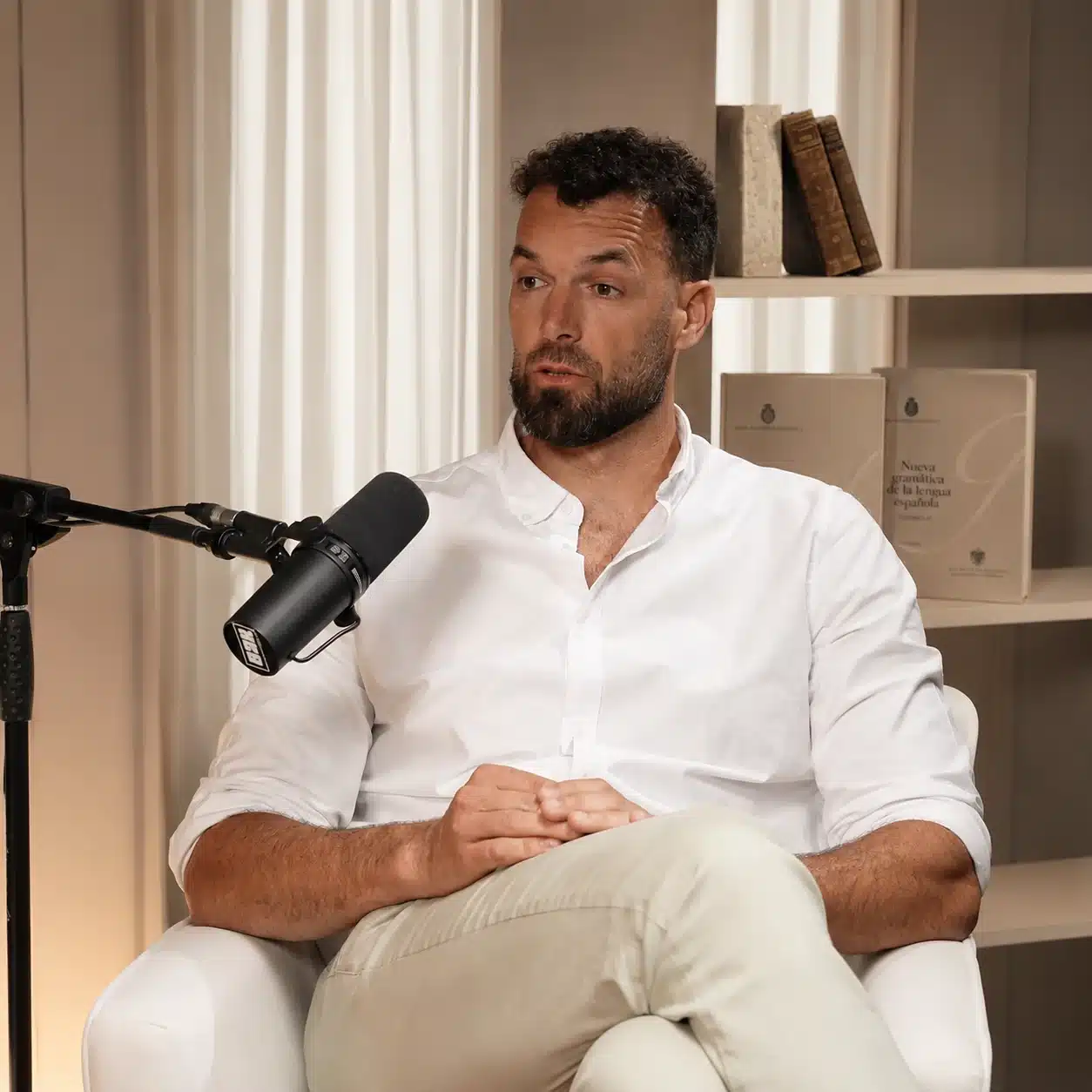
Toni Villar
Founder of Vibefarma. Sixteen years studying the resolution of inflammation — first as a health educator, then alongside the physicians who apply it in clinic. That path led to a meeting with Dr. Charles Serhan at Harvard Medical School, the researcher who discovered SPMs.
He writes here about what the science actually says, with the sources in plain sight. Every article is medically reviewed before it goes out. More about Vibefarma →
Other articles you might find interesting
Resolution of inflammation
What Is Resolution of Inflammation? The Program Your Body Already Has
Resolution of inflammation
Why does some inflammation never fully resolve?
Resolution of inflammation
The resolution interval: the window where it gets decided