
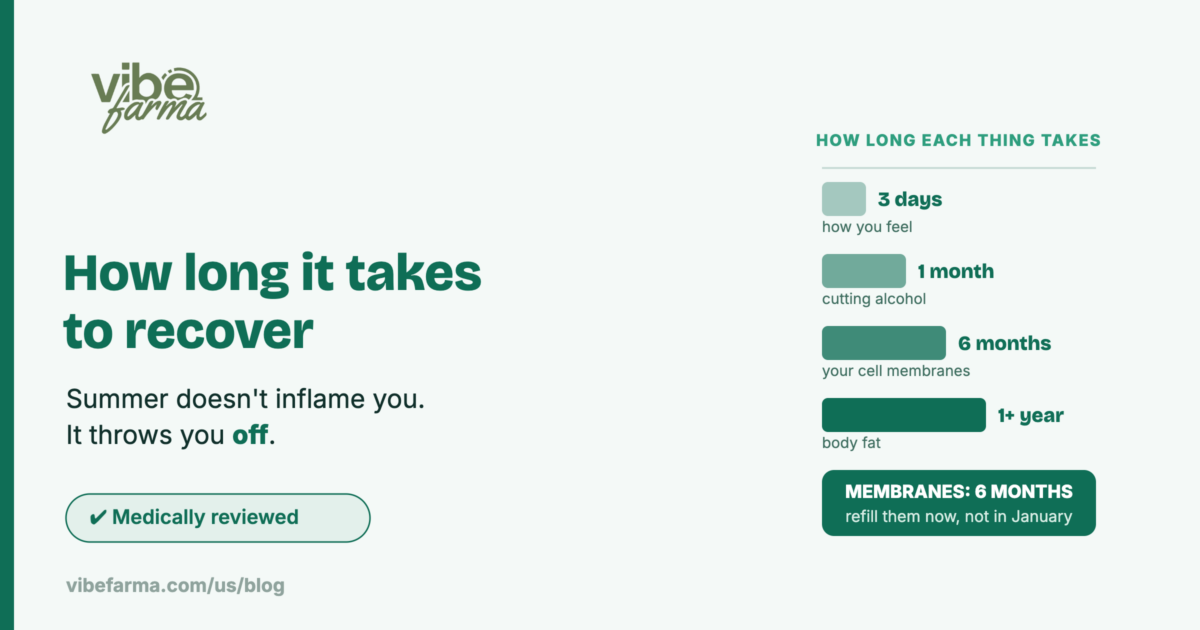
The short version: summer doesn’t inflame you, it throws you off schedule. And what shows most isn’t what you ate, but that for three months you ate, slept and lived at odd hours. One human experiment isolated exactly that: shifting the body clock, without changing food or hours of sleep, raised inflammatory markers by 3% to 29%. Almost everything comes back once the routine does. What doesn’t happen is that it all comes back by Monday: each thing has its own timeline, from three days to more than a year. One of the slowest is the one almost nobody looks at: the raw material in your cell membranes, which takes about six months to reach its new balance. That’s why getting back on track after Labor Day is decided by what you do over the next three months, not the first week.
Contenido
What does summer actually do to your body?
It doesn’t inflame you: it throws you out of order. Inflammation here means something specific: a biological program that switches on when it’s needed and has to shut itself off. What summer touches is less the switch-on than the order in which everything else happens.
Think about what really changed in your life these past three months. You probably ate at odd hours, had dinner late, slept less and worse, drank more than usual and, without noticing, ate a lot less oily fish.
None of that is a disaster on its own. Together, for twelve weeks, it leaves a trace you can measure and date.
Does eating and sleeping at odd hours cause inflammation?
Yes. The clock you live by, on its own, moves inflammatory markers. That isn’t a figure of speech: it’s the result of an experiment designed to isolate exactly that.
A team at Brigham and Women’s Hospital kept healthy adults in a lab and flipped their daily schedule by twelve hours for three days, while making sure they slept the same amount and ate the same food1. The only thing that changed was the timing. That alone was enough for 24-hour IL-6, C-reactive protein, resistin and TNF-alpha to rise by 3% to 29%. Blood pressure went up too.
The authors’ own summary leaves no room: misalignment of the body clock, by itself, raises blood pressure and inflammatory markers.
Over a longer stretch, people who ended up misaligned saw TNF-alpha and IL-10, the one that puts on the brakes, rise at the same time2. It wasn’t “more fire”: the system was switching on and braking without coordinating.
And there’s a detail in that same study worth more than the main finding, because it sits in the comparison group: the people who kept their schedules in sync saw their markers fall week after week. That is, quite literally, getting back to your routine.
Can you fix it by sleeping in on the weekend?
No. One night of catch-up sleep doesn’t undo several weeks of sleeping badly.
Start with what doesn’t hold up. A large review of experimental sleep-loss studies didn’t find that keeping people from sleeping raised CRP, IL-6 or TNF-alpha in the blood3. What did go with higher markers was something else: disturbed sleep, like waking up through the night, and the other extreme, sleeping too long.
What did get measured, and matters more, is how the cells respond. When sleep was cut short in the lab and people’s monocytes were then challenged, their output of IL-6 and TNF-alpha went up clearly4, and that rise was still there after a full night of recovery sleep. It happened in people under forty, not in the older ones.
It’s not the cytokine floating in your blood: it’s how your immune system reacts when someone rings the doorbell, and that took more than one night to settle.
How you feel runs on a different clock. After five nights in a row sleeping from 3 to 7 a.m., people felt steadily worse, and it took three days of normal sleep to feel like themselves again5. Their blood IL-6 and TNF-alpha, meanwhile, didn’t budge.
Does a late dinner change anything if you eat the same?
Yes. Eating late isn’t the same as eating more. Early eating and late eating were compared with identical calories, in adults carrying extra weight, with nutrients, exercise, sleep and even light held steady6.
Eating late raised hunger, pushed up the ghrelin-to-leptin ratio, lowered energy burned while awake and lowered body temperature. In fat tissue, the genes of fat metabolism shifted toward storing more and releasing less.
That study didn’t measure inflammatory markers. What it shows is that the time of your dinner changes your physiology with the same calories on the plate.
What comes back if you quit alcohol for a month?
A lot, and fast. But even one night of heavy drinking changes something you can measure. When healthy volunteers were given the equivalent of a binge, bacterial endotoxin and bacterial DNA showed up in their blood7: material from the gut that normally shouldn’t be circulating.
The reverse has been measured too. People who decided to spend a month without drinking were compared with people who carried on8. Their starting intake was real: about 258 grams of alcohol a week. In four weeks, in the group that stopped, insulin resistance fell 25.9%, blood pressure and weight came down, and several growth factors dropped sharply. In the group that kept drinking, nothing moved.
People chose their own group, and IL-6, TNF-alpha and CRP weren’t measured. What it shows is that one month changes real things, and quickly.
What did summer take out of your membranes?
The EPA and DHA you eat don’t just float around in your blood: they get built into your cell membranes, and what those membranes are made of can be measured.
When researchers looked at young adults who ate little fish, before anyone took anything9, they found this: the people with more DHA in their red-blood-cell membranes had lower TNF-alpha. And those with more arachidonic acid, an omega-6, had higher levels.
It’s an association, and that’s how to read it. But it points straight at the way we look at this: what counts isn’t what you took yesterday, it’s what your membranes are made of today.
In that same study, supplementing for five months didn’t lower IL-6 or CRP on its own. That fits the idea rather than fighting it: omega-3 doesn’t work like an anti-inflammatory that shuts things off. It’s the material your body uses to make the signals that tell the process to wrap up, resolvins, protectins and maresins, and that’s how it supports a healthy inflammatory response.* They’re covered one by one in resolvins, protectins and maresins: what each one does, and from the ground up in what SPMs are.
Whether that material actually gets delivered has been measured in people, too. With placebo, nothing changed. With a marine oil rich in those precursors, more resolution mediators showed up in the blood, and it didn’t stop at the lab report: people’s neutrophils and monocytes got better at capturing bacteria10.
That’s what summer took from your membranes, and it’s what’s worth putting back.
How long does each thing take to recover?
It isn’t one number: each thing recovers at its own pace. This is the real answer to “I’m back in my routine, when will I notice?”
| What | How long it takes |
|---|---|
| How you feel after sleeping badly | about 3 days |
| How reactive your immune cells are after sleeping badly | still off after one night of recovery sleep |
| Fatty acids in your plasma | days |
| Metabolic markers after quitting alcohol | 1 month |
| EPA in the red-blood-cell membrane | halfway at 28 days · new balance at 180 |
| Resolvin precursors when you supplement | clear difference from week 4 to week 12 |
| Inflammatory markers after changing your diet | studies of 12 weeks or more |
| Omega-3 in body fat | more than 12 months |
The two membrane rows come from a study that followed people’s fatty acids while they took fish oil and after they stopped11. EPA in the red-blood-cell membrane takes 28 days to get halfway and doesn’t reach its new balance until day 180. A later study confirmed that each compartment of the body moves at its own speed12.
The diet row: when people switched to a Mediterranean eating pattern, CRP and IL-6 went down13. Take it as an order of magnitude.
And the precursor row comes from twelve weeks of EPA at different amounts: the clear difference shows up between week 4 and week 1214. Two separate measurements, pointing the same way: weeks, not days.
Read it both ways, because both work in your favor. If it takes months to fill the tank, it also takes months to empty it: a normal summer doesn’t leave you at zero. And the other way around: since the tank takes months to fill, the day that counts is today, not January.
Where do I start?
With the clock, then the raw material. In order of what the evidence says, not what sounds best:
- Schedule first, before diet. It’s the one thing a human experiment isolated and measured on its own. Eating and sleeping at steady hours pays off more than any menu change.
- Give sleep more than one night. A ten-hour Sunday sleep-in doesn’t settle the bill. Think in weeks.
- Restock the raw material, every day. It’s the slowest item on the chart, which is why it’s the first one to get going: the membrane takes 28 days to get halfway and six months to reach its new balance. Oily fish if you really eat it several times a week; if not, a marine oil like Omega 3 Pro, which supports your body’s own resolution process.* What decides it isn’t one big week: it’s consistency.
- Alcohol is the fastest lever. A month shows up in things you can measure.
- Don’t expect results in seven days. And be wary of anyone who promises them.
Is there a day when you’re fully recovered?
No. Each tissue in your body runs on its own turnover clock, which is why this article gives separate timelines instead of one.
What the evidence does back up is the idea behind all of this: being out of sync has measurable effects, getting back in sync reverses them, and the raw material your body uses to close its inflammatory responses comes in through your mouth and takes months to settle in. That isn’t motivation. It’s logistics.
Frequently asked questions
How long does it take your body to recover from summer?
It depends on what you measure. How you feel after sleeping badly comes back in about three days. Metabolic markers move within a month of quitting alcohol. EPA in your red-blood-cell membranes takes 28 days to get halfway and around six months to reach its new balance. There’s no single timeline.
Does eating at odd hours cause inflammation?
A controlled experiment in healthy adults flipped their schedules for three days while keeping sleep and food the same, and 24-hour inflammatory markers rose by 3% to 29%. It’s the most direct data there is on meal and sleep timing and inflammation in people.
Does catching up on sleep over the weekend fix a bad week?
For how you feel, it helps: it takes about three days of normal sleep. For how reactive your immune cells are, it isn’t enough: the rise in IL-6 and TNF-alpha output after short sleep was still there after a full night of recovery sleep.
Does eating dinner late make you gain weight or cause inflammation?
Eating late with the same calories increases hunger, lowers the energy you burn while awake and shifts fat-metabolism genes toward storing more. That study didn’t measure inflammatory markers, so it says nothing either way about inflammation.
How long does it take to raise your Omega-3 Index?
EPA in the red-blood-cell membrane takes 28 days to get halfway to its new level and reaches a steady state around day 180. DHA was erratic in that same study, and the authors say so. You see changes in the blood sooner, in days or weeks, but that reflects what you’ve eaten lately, not your reserve.
Does omega-3 work like an anti-inflammatory?
No. In a five-month study in healthy young adults, supplementing didn’t significantly lower IL-6 or CRP on its own, while people with more DHA in their membranes had lower TNF-alpha. EPA and DHA are the raw material your body uses to make the signals that close an inflammatory response, which is different from a direct anti-inflammatory effect.
Can you tell the difference after a month without alcohol?
In people who stopped for a month, compared with people who kept drinking, insulin resistance fell by about 26%, along with blood pressure and weight. People chose their own group and inflammatory markers weren’t measured, but the metabolic change was clear and fast.
References
- Morris CJ, Purvis TE, Hu K, Scheer FAJL. Circadian misalignment increases […] risk factors in humans. PNAS, 2016;113(10):E1402-11.
- Wright KP Jr, Drake AL, Frey DJ, et al. Influence of sleep deprivation and circadian misalignment on cortisol, inflammatory markers, and cytokine balance. Brain Behav Immun, 2015;47:24-34.
- Irwin MR, Olmstead R, Carroll JE. Sleep disturbance, sleep duration, and inflammation: a systematic review and meta-analysis. Biol Psychiatry, 2016;80(1):40-52.
- Carroll JE, Carrillo C, Olmstead R, et al. Sleep deprivation and divergent toll-like receptor-4 activation of cellular inflammation in aging. Sleep, 2015;38(2):205-11.
- Lekander M, Andreasson AN, Kecklund G, et al. Subjective health perception in healthy young men changes in response to experimentally restricted sleep and subsequent recovery sleep. Brain Behav Immun, 2013;34:43-6.
- Vujović N, Piron MJ, Qian J, et al. Late isocaloric eating increases hunger, decreases energy expenditure, and modifies metabolic pathways […]. Cell Metab, 2022;34(10):1486-1498.e7.
- Bala S, Marcos M, Gattu A, et al. Acute binge drinking increases serum endotoxin and bacterial DNA levels in healthy individuals. PLoS One, 2014;9(5):e96864.
- Mehta G, Macdonald S, Cronberg A, et al. Short-term abstinence from alcohol and changes in […] risk factors, liver function tests […]. BMJ Open, 2018;8(5):e020673.
- Flock MR, Skulas-Ray AC, Harris WS, et al. Effects of supplemental long-chain omega-3 fatty acids and erythrocyte membrane fatty acid content on circulating inflammatory markers in a randomized controlled trial of healthy adults. Prostaglandins Leukot Essent Fatty Acids, 2014;91(4):161-8.
- Souza PR, Marques RM, Gomez EA, et al. Enriched marine oil supplements increase peripheral blood specialized pro-resolving mediators concentrations and reprogram host immune responses. Circulation Research, 2020;126(1):75-90.
- Katan MB, Deslypere JP, van Birgelen AP, et al. Kinetics of the incorporation of dietary fatty acids into serum cholesteryl esters, erythrocyte membranes, and adipose tissue: an 18-month controlled study. J Lipid Res, 1997;38(10):2012-22.
- Browning LM, Walker CG, Mander AP, et al. Incorporation of eicosapentaenoic and docosahexaenoic acids into lipid pools when given as supplements providing doses equivalent to typical intakes of oily fish. Am J Clin Nutr, 2012;96(4):748-58.
- Schwingshackl L, Hoffmann G. Mediterranean dietary pattern, inflammation and endothelial function: a systematic review and meta-analysis of intervention trials. Nutr Metab Cardiovasc Dis, 2014;24(9):929-39.
- Lamon-Fava S, So J, Mischoulon D, et al. Dose- and time-dependent increase in circulating anti-inflammatory and pro-resolving lipid mediators following eicosapentaenoic acid supplementation. Prostaglandins Leukot Essent Fatty Acids, 2021;164:102219.
✔️ Medical review
This article was reviewed by Dr. Jorge Oseguera Anguiano, a physician specializing in functional and pro-resolution medicine, to verify the accuracy of its content.
* These statements have not been evaluated by the Food and Drug Administration. These products are not intended to diagnose, treat, cure, or prevent any disease.
Toni Villar
Founder of Vibefarma. Sixteen years studying the resolution of inflammation — first as a health educator, then alongside the physicians who apply it in clinic. That path led to a meeting with Dr. Charles Serhan at Harvard Medical School, the researcher who discovered SPMs.
He writes here about what the science actually says, with the sources in plain sight. Every article is medically reviewed before it goes out. More about Vibefarma →
Other articles you might find interesting
Resolution of inflammation
Why your body can’t make the omega-3 it needs
Resolution of inflammation
How long your body takes to recover from summer
Resolution of inflammation
The resolution interval: the window where it gets decided