
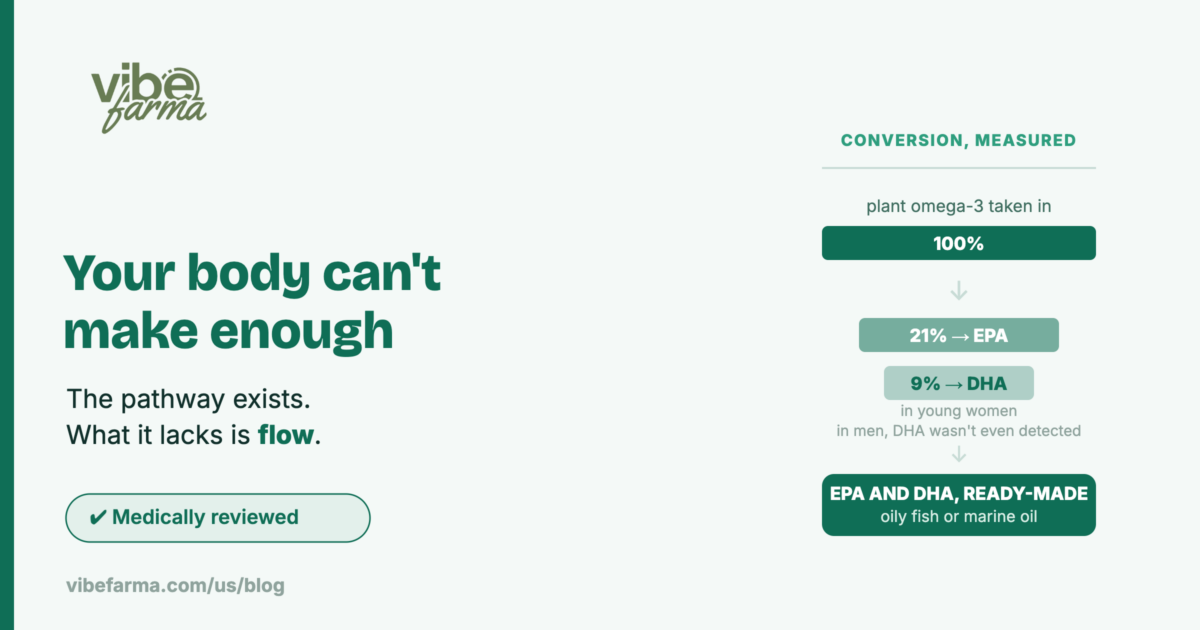
The short version: your body does know how to make EPA and DHA from plant omega-3. What it lacks is flow. Measured with labeled carbon, young women convert about 21% of plant omega-3 into EPA and around 9% into DHA; in men, labeled DHA never showed up at all. And a good share of what comes in never even tries: it’s burned as fuel within the first 24 hours. On top of that, two genes decide how much of that little gets through the bottleneck, and not everyone has the same version. The practical takeaway is short: if what you need is EPA and DHA, the reliable route is to eat them ready-made, from oily fish or a marine oil, instead of counting on your body to build them from walnuts, flax or chia.
Contenido
Does your body make the EPA and DHA it needs?
Yes, but only a trickle. Your body can stretch plant omega-3 into the long-chain kind, and it does it drop by drop.
The omega-3 in walnuts, flaxseed and chia is alpha-linolenic acid, or ALA. The kind your body uses to build cell membranes and make signals is EPA and DHA, which are longer. Between one and the other there’s a chain of enzymes, and that chain works. The question is how many gallons a minute it moves.
It has been measured the cleanest way there is: by tagging plant omega-3 with a carbon label and following where each atom goes for three weeks. In young women, a little over 20% ended up as EPA and about 9% as DHA1. In men, labeled DHA didn’t turn up anywhere in 21 days2.
And that’s only the first step. The second one is even narrower: the step from EPA to DHA came in below 0.1% of the plant omega-3 in the diet5.
The people who have spent years measuring this put it plainly: conversion is limited in men, very low toward DHA, and somewhat better in women3.
What happens to the ALA that isn’t converted?
It isn’t lost. It’s burned.
About one fifth of plant omega-3 leaves your body on your breath as CO₂ within the first 24 hours, and in men, a third. It gets used as fuel before anything has time to lengthen it.
The rest doesn’t sit around waiting either. Following the labeled carbon, it shows up inside ordinary saturated and monounsaturated fats4.
In other words, your body doesn’t snub plant omega-3. It uses it for energy and as a building block. What it hardly does is lengthen it.
Is it about the omega-6 to omega-3 ratio?
No. Cutting omega-6 isn’t enough: what moves the needle is how much omega-3 you take in.
The Western diet has a real imbalance between omega-6 and omega-3, on the order of fifteen to one, and that environment exists: the two compete for the same enzymes, so too much of one gets in the way of the other.
But when researchers set out to measure what actually decides conversion, the answer was more useful than expected: what matters is the absolute amount of each one in your diet, not the ratio between them5.
That changes the advice, and for the better. You don’t have to chase a number. You have to get enough omega-3 in.
Why do two people on the same diet end up with different levels?
Because two genes decide how much gets through, and that’s written in from the start.
The two enzymes that set the pace are called delta-6 and delta-5 desaturase, and they’re encoded by two neighboring genes: FADS2 and FADS1.
This has been looked at in nearly 9,000 people6. Those who carry one of the variants have more plant omega-3 and less EPA in their blood: the material gets stuck before the bottleneck. The authors read it the way it looks: they convert less. And the statistical strength behind that finding is among the highest you’ll see in biology.
There’s also a second step with its own gene, ELOVL2, which pushes the other way: more EPA and less DHA. So there isn’t one bottleneck, there are two, and the genetic lottery can land on one, the other, or neither.
Here’s the awkward part: you don’t know which one you got. It isn’t in any routine blood panel, and even if you knew, you couldn’t change it. What you can change is where your EPA and DHA come from.
Does your body resolve inflammation less well with age?
Yes: with age, inflammation switches on the same, but closes less well. It’s the finding in this article I care about most, because it was measured in people and because it runs against what you’d expect.
Researchers triggered a small, controlled inflammation in the skin of younger and older volunteers and followed both phases: the switch-on and the shutdown7. The switch-on was the same in both groups. The shutdown wasn’t: in the older group it was clearly impaired.
They also found why. The older people’s macrophages had less TIM-4, the receptor they use to swallow dead cells, which is the clean-up step. And they went further: when that pathway was corrected with a drug, the older people’s macrophages went back to behaving like a young person’s. They sum it up in a line worth reading slowly: it’s the first resolution defect identified in humans that has been reversed.
What reversed it was a drug, not a supplement, and that study didn’t measure omega-3. What it shows is something else, and it’s plenty: the ability to close an inflammatory response slows down with age, it can be measured, and it isn’t set in stone.
Isn’t it all about habits?
No. With age there’s more omega-3 in your membranes, not less. The obvious guess would be that people close worse with age because they run low on material, and the data say the opposite.
The average Omega-3 Index in the US population is 4.12%, and it rises with age8. Older adults have, on average, more EPA and DHA in their membranes than younger ones.
Having the material and knowing how to use it are two different things, and what wears down with the years is the second one.
But watch out for the easy conclusion, which would be “then omega-3 doesn’t matter, this is about habits.” Look at that number again: 4.12% on average, when the target people aim for is 8%. Older adults having more than younger ones doesn’t mean they have enough. It means both groups are running short, and older adults a bit less so.
And that’s the reading that matters: machinery that’s already slowing down is exactly the kind that can’t afford to run short of material. It isn’t material or habits. Without material, habits have nothing to work with.
Where do I get EPA and DHA, then?
Not from plants. From fish. If what you need is EPA and DHA, the reliable route is to eat them already made. That isn’t a preference: it follows, plainly, from everything above.
Look at what we’ve got. The plant route has a small flow to begin with. In men, labeled DHA never appeared. The jump from EPA to DHA stays under 0.1%. A fifth gets burned within a day. And what makes it through the bottleneck depends on two genes you don’t know you have and can’t change.
With all that stacked up, counting on your body to lengthen the omega-3 in walnuts, flax or chia means betting on a conversion chain that, measured in people, barely moves anything. Oily fish and marine oil supplements skip the whole chain: they bring EPA and DHA already formed.
To be clear about what this doesn’t mean: plant omega-3 is an essential fatty acid, your diet needs it, and it has jobs of its own. What it isn’t is a reliable source of EPA and DHA.
ALA is an ingredient. EPA and DHA are the finished product. And the factory that connects them runs at half speed, and in many people at far less.
This matters because of what your body does with them next. With that EPA and DHA it builds the membranes of its cells and makes the signals that tell an inflammatory response to wrap up: resolvins, protectins and maresins. Without raw material, there’s nothing to make them from.
What does your body do with EPA and DHA once they’re in?
It builds its own resolution signals with them. Getting EPA and DHA ready-made, from oily fish or from a marine oil like Omega 3 Pro, supports your body’s normal resolution process and a healthy inflammatory response.*
How those signals work, one family at a time, is in resolvins, protectins and maresins: what each one does. If you’d rather start from the beginning, here’s what SPMs are.
Frequently asked questions
Does the human body make omega-3?
It makes EPA and DHA from plant omega-3, alpha-linolenic acid, but not efficiently. Measured with labeled carbon, net conversion to EPA was about 21% in young women and conversion to DHA around 9%; in men, with the same design, labeled DHA wasn’t detected at all. Alpha-linolenic acid itself is essential: that one you do have to eat, because the body doesn’t make it.
Why is so little converted?
Three reasons that add up. The two enzymes that set the pace, delta-6 and delta-5 desaturase, are a bottleneck. A large share of plant omega-3 is burned as fuel within the first 24 hours. And omega-6 from the diet competes for the same enzymes.
Is it about the omega-6 to omega-3 ratio?
Less than people say. A study that measured conversion on different diets concluded that what drives it is the absolute amount of each fatty acid in the diet, not the ratio between them. In practice, what moves the needle most is how much omega-3 you get.
Do genetics affect my omega-3 levels?
Yes, and it has been measured in nearly 9,000 people. Variants in the FADS1 and FADS2 genes are linked to more plant omega-3 and less EPA in the blood, which is read as a lower conversion rate. Another gene, ELOVL2, affects the next step in the opposite direction. It’s an association with a blood marker, not a diagnosis.
Does the body resolve inflammation less well with age?
When a controlled, short-lived inflammation was triggered in the skin of younger and older volunteers, the onset was similar in both groups but the resolution phase was substantially impaired in the older group. The cause identified was a lower ability of macrophages to remove dead cells. In that study, a p38 inhibitor drug reversed the defect, not a supplement.
Do you have less omega-3 in your body as you get older?
Not according to population data. In the US NHANES analysis, the average Omega-3 Index was 4.12% and rose with age. What gets worse with the years, according to the available evidence, is the ability to use that material to close an inflammatory response, not the amount of material.
Can I get my omega-3 from walnuts, flax or chia alone?
For alpha-linolenic acid, yes: it’s an essential fatty acid and those foods supply it. For EPA and DHA, not reliably. Conversion measured in people is low, in men labeled DHA wasn’t detected, and it depends on genetic variants you don’t know you carry. If you’re after EPA and DHA, the dependable route is to eat them already formed: oily fish or a marine oil supplement.
How much plant omega-3 would I need to eat to cover it?
There’s no reliable way to do that math, precisely because the conversion rate varies a lot from person to person and is very low toward DHA. That’s why official recommendations are written in EPA and DHA directly, not in plant omega-3 equivalents.
References
- Burdge GC, Wootton SA. Conversion of alpha-linolenic acid to eicosapentaenoic, docosapentaenoic and docosahexaenoic acids in young women. Br J Nutr, 2002;88(4):411-20.
- Burdge GC, Jones AE, Wootton SA. Eicosapentaenoic and docosapentaenoic acids are the principal products of alpha-linolenic acid metabolism in young men. Br J Nutr, 2002;88(4):355-63.
- Burdge GC, Calder PC. Conversion of alpha-linolenic acid to longer-chain polyunsaturated fatty acids in human adults. Reprod Nutr Dev, 2005;45(5):581-97.
- Burdge GC, Wootton SA. Conversion of alpha-linolenic acid to palmitic, palmitoleic, stearic and oleic acids in men and women. Prostaglandins Leukot Essent Fatty Acids, 2003;69(4):283-90.
- Goyens PLL, Spilker ME, Zock PL, Katan MB, Mensink RP. Conversion of alpha-linolenic acid in humans is influenced by the absolute amounts of alpha-linolenic acid and linoleic acid in the diet and not by their ratio. Am J Clin Nutr, 2006;84(1):44-53.
- Lemaitre RN, Tanaka T, Tang W, et al. Genetic loci associated with plasma phospholipid n-3 fatty acids: a meta-analysis of genome-wide association studies from the CHARGE Consortium. PLoS Genet, 2011;7(7):e1002193.
- De Maeyer RPH, van de Merwe RC, Louie R, et al. Blocking elevated p38 MAPK restores efferocytosis and inflammatory resolution in the elderly. Nat Immunol, 2020;21(6):615-625.
- Powers CD, Sternberg MR, Mineva EM, et al. Over half of the United States population had an undesirably low omega-3 index based on erythrocyte membrane measurements: results from the cross-sectional NHANES from August 2021 to August 2023. Curr Dev Nutr, 2026;10(6):107715.
✔️ Medical review
This article was reviewed by Dr. Jorge Oseguera Anguiano, a physician specializing in functional and pro-resolution medicine, to verify the accuracy of its content.
* These statements have not been evaluated by the Food and Drug Administration. These products are not intended to diagnose, treat, cure, or prevent any disease.

Toni Villar
Founder of Vibefarma. Sixteen years studying the resolution of inflammation — first as a health educator, then alongside the physicians who apply it in clinic. That path led to a meeting with Dr. Charles Serhan at Harvard Medical School, the researcher who discovered SPMs.
He writes here about what the science actually says, with the sources in plain sight. Every article is medically reviewed before it goes out. More about Vibefarma →
Other articles you might find interesting
Resolution of inflammation
What Are SPMs and How They Resolve Inflammation
Resolution of inflammation
The resolution interval: the window where it gets decided
Resolution of inflammation
What Is Resolution of Inflammation? The Program Your Body Already Has