
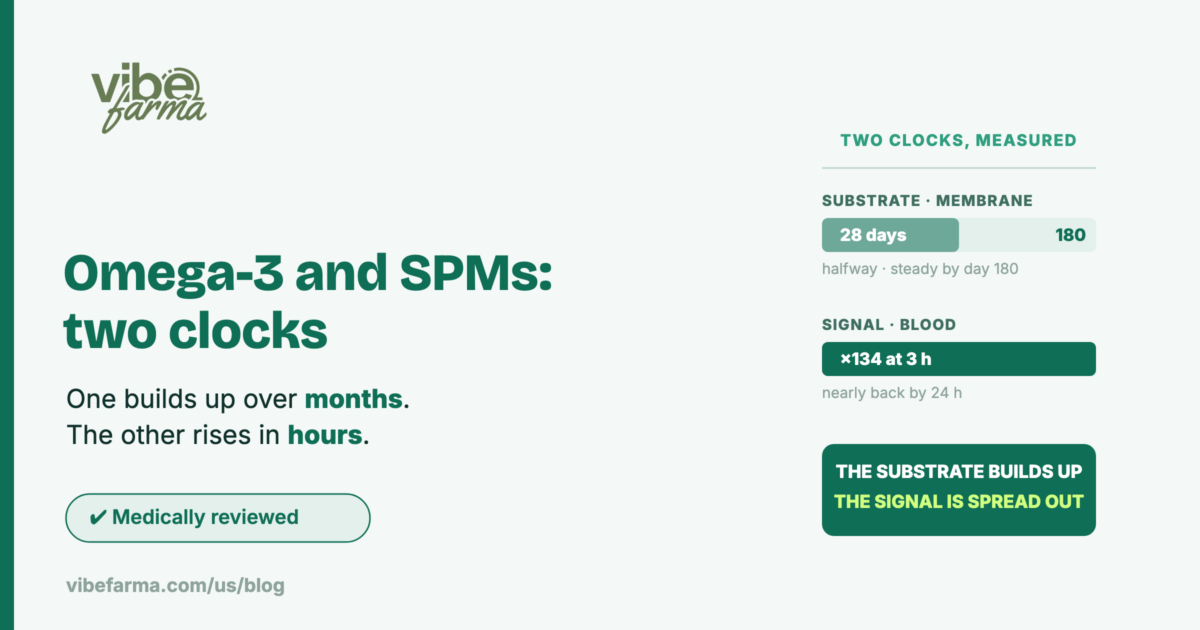
The short version: omega-3s and SPMs don’t do the same job, and they don’t run on the same clock. EPA and DHA are the raw material: they settle into your cell membranes slowly —red-blood-cell EPA takes 28 days to get halfway there and about 180 to level off— and that is where your body builds its own resolution signals from. SPM precursors, on the other hand, are the next step of that chain already taken: they show up in your blood within hours and are nearly gone the next day. That’s why the substrate is taken to build up, and the signal is spread across the day. They don’t compete: they are two parts of the same system, each with its own clock.
Contenido
What does each one do in the chain?
Omega-3 is the raw material; SPM precursors are the first step already climbed.
Your body makes its resolution signals through a chain of steps. At the top sit EPA and DHA, stored in your cell membranes. When they’re needed, an enzyme turns them into intermediate molecules —18-HEPE, from EPA, and 17-HDHA and 14-HDHA, from DHA— and from those come resolvins, protectins and maresins. If those names are new to you, here’s what SPMs are, from the beginning.
Human neutrophils turn 17-HDHA into resolvins1, and human enzymes convert 18-HEPE into the E-series resolvins23.
So there are two ways to feed that chain. Supply the material at the top —EPA and DHA— or also supply the intermediate step, which is what SPM-enriched marine oils do.
Why isn’t taking more omega-3 enough?
Because more omega-3 means more precursors, but the last step is decided by your body, not by the amount you take.
The first half works the way you’d expect. When you take more EPA and DHA, precursors in the blood rise in a straight line with the amount, with very little difference from one person to the next4. With EPA, 18-HEPE goes up fivefold; with DHA, 17-HDHA and 14-HDHA go up threefold5.
The second half is a different story. The step from precursor to finished resolvin doesn’t follow the amount: finished resolvins rise unevenly, as a 2025 review by De Souza and colleagues puts it11, and Philip Calder, one of the leading omega-3 researchers, says it plainly: the link between what you take and which specific SPMs appear “is not clear”6.
The reason is timing. An inflammatory response has two phases, and your cells switch production between them: first they make the signals that switch the response on, and then those same cells start making the ones that close it7. The enzyme that does the closing work is the same one that makes switch-on signals3. Your body doesn’t turn all its EPA into resolvins just because it can: it does it when the process calls for it.
That’s why the substrate alone doesn’t guarantee the signal, and why it makes sense to supply the signal on top of the substrate.
How long does omega-3 take to reach your cells?
Weeks to start rising in the membrane, and months to settle in.
With fish oil every day, EPA in the blood hits its ceiling in four to eight weeks8. In the red-blood-cell membrane it moves more slowly: it takes 28 days to get halfway and about 180 to level off. In body fat, years.
Put another way: your red-blood-cell membrane reflects what you’ve eaten over the last month or two. That’s why the Omega-3 Index is measured there, and why a two-week bottle barely moves it: it doesn’t even get halfway.
The substrate is a reserve you fill with consistency. It doesn’t fill up in days, and it doesn’t empty in days. What counts is taking it every day, for months.
And how long do SPM precursors take?
Hours. And by the next day they’re nearly gone.
In a placebo-controlled trial, after a single serving of an enriched marine oil, blood SPMs rose over the following hours, and more so the larger the serving9.
With the ingredient maker’s own oil10, plasma 18-HEPE rose 134-fold at three hours, dropped by half at six, and at 24 hours was only three times above where it started. 17-HDHA rose up to 38-fold, and 14-HDHA 46-fold. Several finished SPMs rose in that same study too, including resolvin D5 and protectin DX.
The signal doesn’t build up like the substrate: it rises, runs its course and falls. It has to be supplied again every day.
If I take SPMs, do I still need omega-3?
Yes, you do. The signal comes and goes; the reserve is what stays.
Three reasons:
- The substrate is the reserve SPMs come from. Your body makes its resolution signals from the EPA and DHA already in your membranes12. If the reserve is low, there’s less to draw on.
- More substrate means more of your own precursor, in a straight line with the amount4. Omega-3 keeps background production going.
- Omega-3 is also structure. It’s part of the membranes of your retina, brain and heart, and does work there that has nothing to do with the signal.
The enriched oil also contains EPA and DHA —in the 24-hour study, most of the oil was omega-310—, but the amount in a daily serving is small. Enriched oils supply precursors on top of a low amount of EPA and DHA11.
And the other way around: omega-3 alone doesn’t guarantee the signal shows up when it’s needed. Two parts, not two options.
How do you combine them day to day?
The substrate once a day. The signal spread across three meals.
The logic comes straight from the two clocks. The reserve fills slowly and doesn’t need to be split up: one daily serving, at the same time every day, is enough. The signal rises and falls within hours, so it makes sense to spread it out.
| Breakfast | Lunch | Dinner | Per day | |
|---|---|---|---|---|
| Omega 3 Pro (substrate) | — | 2 | — | 2 softgels · 1,600 mg EPA+DHA |
| SPMs Pro (signal) | 1 | 1 | 1 | 3 softgels · 450 mg EPA+DHA and 255 µg precursors |
That adds up to 2,050 mg of EPA+DHA a day, plus the measured precursors: 75 µg of 18-HEPE, 120 µg of 17-HDHA and 60 µg of 14-HDHA.
If you weren’t taking omega-3 before, SPMs Pro runs at 2-2-2 (six a day) for the first month while Omega 3 Pro fills the reserve, which is exactly the slow part. That month adds up to 2,500 mg of EPA+DHA and 510 µg of precursors. From month two, 1-1-1.
What’s still missing: there is no trial yet that has tested the two together. The combination comes from how the chain works, and that part has been measured in people.
Where to start
Omega-3 is the substrate your body uses to build its own resolution signals: it supports the body’s normal resolution process.* Start with the slow part, the reserve: omega-3 every day, for months. The signal comes on top, spread across the day.
These statements have not been evaluated by the Food and Drug Administration. These products are not intended to diagnose, treat, cure, or prevent any disease.
Frequently asked questions
Can I take omega-3 and SPMs at the same time?
Yes. They act at different steps of the same chain: omega-3 supplies the EPA and DHA your body uses to make its resolution mediators, and enriched oils supply precursors of those mediators, such as 18-HEPE, 17-HDHA and 14-HDHA. Taken together, omega-3 goes once a day with lunch and the SPMs are spread across breakfast, lunch and dinner.
How long does omega-3 take to reach your cell membranes?
Red-blood-cell EPA takes 28 days to reach half of its final level and settles at a steady level after about 180 days of daily intake. That’s why the membrane reflects what you’ve taken over the last month or two, and why omega-3 is meant to be taken consistently for months.
How long do SPM precursors stay in the blood?
After a single serving of an enriched marine oil, plasma 18-HEPE rose 134-fold at three hours and at 24 hours was about three times above its starting level. They rise within hours and fall within a day, which is why it makes sense to take them every day and spread out.
If I take more omega-3, do I make more resolvins?
You make more precursors: in a one-year trial, blood 18-HEPE and 17-HDHA rose in a straight line with the amount of EPA and DHA. The next step, from precursor to resolvin, doesn’t follow the amount as directly, because your body triggers it according to the phase of the inflammatory response.
Do SPM supplements contain omega-3?
Yes. Marine oils enriched in SPM precursors are fish oil, so they also supply EPA and DHA, although a daily serving provides less than a concentrated omega-3. SPMs Pro provides 450 mg of EPA+DHA in its three daily softgels; Omega 3 Pro, 800 mg per softgel.
Have any studies tested the two together?
Not yet: no trial has been designed to compare regular omega-3 with and without an enriched fraction. What has been measured in people is each part separately: how EPA builds up in the membrane, how precursors rise with the amount of omega-3, and how they rise in the blood after taking an enriched oil.
References
- Serhan CN, Hong S, Gronert K, et al. Resolvins: a family of bioactive products of omega-3 fatty acid transformation circuits initiated by aspirin treatment that counter proinflammation signals. J Exp Med, 2002;196(8):1025-37.
- Oh SF, Pillai PS, Recchiuti A, Yang R, Serhan CN. Pro-resolving actions and stereoselective biosynthesis of 18S E-series resolvins in human leukocytes and murine inflammation. J Clin Invest, 2011;121(2):569-81.
- Tjonahen E, Oh SF, Siegelman J, et al. Resolvin E2: identification and anti-inflammatory actions: pivotal role of human 5-lipoxygenase in resolvin E series biosynthesis. Chem Biol, 2006;13(11):1193-202.
- Ostermann AI, West AL, Schoenfeld K, et al. Plasma oxylipins respond in a linear dose-response manner with increased intake of EPA and DHA: results from a randomized controlled trial in healthy humans. Am J Clin Nutr, 2019;109(5):1251-63.
- So J, Wu D, Lichtenstein AH, et al. EPA and DHA differentially modulate monocyte inflammatory response […] in part via plasma specialized pro-resolving lipid mediators: a randomized, double-blind, crossover study. Atherosclerosis, 2021;316:90-8.
- Calder PC. Eicosapentaenoic and docosahexaenoic acid derived specialised pro-resolving mediators: concentrations in humans and the effects of age, sex, disease and increased omega-3 fatty acid intake. Biochimie, 2020;178:105-23.
- Levy BD, Clish CB, Schmidt B, Gronert K, Serhan CN. Lipid mediator class switching during acute inflammation: signals in resolution. Nat Immunol, 2001;2(7):612-9.
- Katan MB, Deslypere JP, van Birgelen AP, Penders M, Zegwaard M. Kinetics of the incorporation of dietary fatty acids into serum cholesteryl esters, erythrocyte membranes, and adipose tissue: an 18-month controlled study. J Lipid Res, 1997;38(10):2012-22.
- Souza PR, Marques RM, Gomez EA, et al. Enriched marine oil supplements increase peripheral blood specialized pro-resolving mediators concentrations and reprogram host immune responses: a randomized double-blind placebo-controlled study. Circ Res, 2020;126(1):75-90.
- Irún P, Carrera-Lasfuentes P, Sánchez-Luengo M, et al. Pharmacokinetics and changes in lipid mediator profiling after consumption of specialized pro-resolving lipid-mediator-enriched marine oil in healthy subjects. Int J Mol Sci, 2023;24(22):16143.
- de Souza LC, Moris JM, Gordon PM, Heileson JL, Funderburk LK. From fish oil to resolution: a narrative review on the potential of SPM-enriched marine oil […]. Nutrients, 2025;17(12):2014.
✔️ Medical review
This article was reviewed by Dr. Jorge Oseguera Anguiano, a physician specializing in functional and pro-resolution medicine, to verify the accuracy of its content.
* These statements have not been evaluated by the Food and Drug Administration. These products are not intended to diagnose, treat, cure, or prevent any disease.

Toni Villar
Founder of Vibefarma. Sixteen years studying the resolution of inflammation — first as a health educator, then alongside the physicians who apply it in clinic. That path led to a meeting with Dr. Charles Serhan at Harvard Medical School, the researcher who discovered SPMs.
He writes here about what the science actually says, with the sources in plain sight. Every article is medically reviewed before it goes out. More about Vibefarma →
Other articles you might find interesting
Resolution of inflammation
The resolution interval: the window where it gets decided
Resolution of inflammation
Why your body can’t make the omega-3 it needs
Resolution of inflammation
Resolvins, protectins and maresins: what each one does