
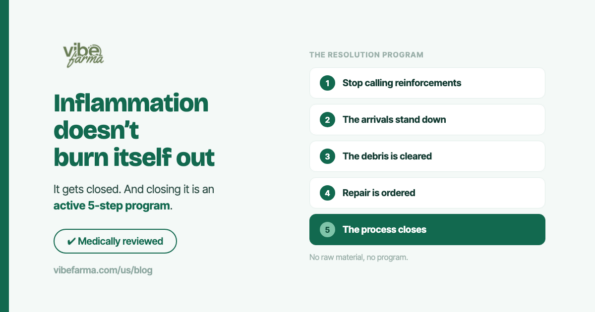
The short version: inflammation doesn’t burn itself out. Resolving it is an active program your body runs in five steps: stop calling in reinforcements, stand down the cells that arrived, clear the debris, order repair, and close the process. For decades it was assumed inflammation ended passively, by exhaustion. Today resolution is described as a biosynthetically active phase with its own molecules — the SPMs (specialized pro-resolving mediators). Some of them, the lipoxins, come from arachidonic acid; the others — resolvins, protectins and maresins — your body builds from the EPA and DHA in your omega-3. And one detail changes everything: that program starts within the first hours, not at the end. With no raw material on hand, the program has nothing to run on.
You cut your hand. A few days later the area doesn’t hurt, the redness is gone, and skin is skin again. We assume that happens “just because”: whatever caused it stopped, and the inflammation faded out like a fire running out of wood.
That’s not how it works. And understanding why is probably the most useful thing you’ll read about inflammation.
Contenido
For decades we thought inflammation switched itself off
The classic model said acute inflammation ended passively: the signals that had switched it on simply diluted away and, with nothing to sustain it, the process shut down on its own. It was a reasonable idea. It was also wrong.
Charles Serhan‘s group at Harvard described resolution as an active, coordinated program that starts within the first hours of the inflammatory response1. It isn’t what’s left over once inflammation ends: it’s a process of its own, with its own phases, molecules and timing. Resolution is now described as a biosynthetically active phase35.
It’s the difference between putting a fire out and closing the site down. Firefighters put the fire out. But if nobody clears the burnt material and repairs the damage, the area stays black. Your body has one crew that puts it out and another that clears and rebuilds — and they are different processes.
The resolution program, in five steps
This is what happens, in order, when inflammation truly resolves1:
1Stop calling in reinforcements. Neutrophil recruitment halts — those are the cells that arrive first at the site. While they keep coming, the process can’t close.
2The ones that arrived stand down. Their programmed death — apoptosis — is triggered, in an orderly way and without damaging the surrounding tissue.
3Someone clears the debris: efferocytosis. Macrophages engulf those spent cells. Engulfing is phagocytosis, the general mechanism by which a cell eats something — a microbe, a particle. But when what it eats is the body’s own apoptotic cells, it has its own name: efferocytosis, from the Latin effero, “to carry out for burial.” That’s not a vocabulary detail: without that clearance, the debris keeps the alarm ringing and the process cannot close.
4The order to repair goes out. That same clearance releases the signals that set the tissue rebuilding. Clearing and repairing aren’t two things in a row: one triggers the other.
5The process is declared over. Macrophages leave the area and the tissue is back to what it was. The inflammation hasn’t been switched off: it has been resolved.
Three names worth keeping straight
- Apoptosis — programmed cell death. The cell shuts down in an orderly way, without rupturing or spilling its contents. That’s step 2.
- Phagocytosis — the general mechanism by which a cell engulfs and digests something: a microbe, a particle, a fragment.
- Efferocytosis — the specific phagocytosis of the body’s own apoptotic cells. That’s step 3, and it’s the one that hauls away the rubble so the tissue can be repaired.
Put simply: efferocytosis is a kind of phagocytosis — the one that deals with your own cells — and it only makes sense after apoptosis. The three run as a chain, not in parallel.
None of these five steps is automatic. Every one of them needs someone to give the order.
The beginning programs the end
Here’s the detail almost nobody talks about, and it’s so good that the scientific paper itself is titled after it: “Resolution of inflammation: the beginning programs the end”1.
The shutdown program doesn’t start when inflammation ends. It starts at the same time inflammation switches on, within the first hours. While the site is still in full swing, how and when it will close is already being decided.
And there’s a changing of the guard: the mediators that dominate early on — prostaglandins and leukotrienes — give way to other molecules, the lipoxins, which begin the termination sequence1. The same response that switches the process on is the one that, if all goes well, sets up its ending.
The practical consequence is uncomfortable but clear: your body closes the process with the material it already had, not with what you give it once something already hurts.
What the program is made of: the SPMs
The molecules running all of this are called SPMs: specialized pro-resolving mediators. They’re a family that includes lipoxins, resolvins, protectins and maresins23.
They work as stop signals: they terminate the inflammatory response once it’s no longer needed and actively promote tissue repair and regeneration. As Fredman and Serhan describe it, their reported actions also include limiting pain4. They don’t block anything: they order the close.
And where do they come from? Resolvins, protectins and maresins are built from your omega-3 — the EPA and DHA23 — and they shorten the time neutrophils spend at the site1.
This is where omega-3 fits into the whole story. It isn’t an anti-inflammatory that shuts things down from the outside: it’s the raw material your body uses to build the molecules that close the process. With no substrate available, the program has nothing to run on. We lay out the full chain on the science page.
What happens when inflammation doesn’t resolve
When the resolution response isn’t effective or doesn’t arrive in time, inflammation can become chronic: instead of closing, it stays in the background, at a low level, for months or years43. It’s what we usually call chronic inflammation — and seen this way, it isn’t inflammation that turned permanent, but inflammation that never got resolved.
This has changed how researchers look at persistent inflammatory situations. One well-documented example, and we quote it as published science rather than as anything to do with a supplement: atherosclerosis is described today not only as inflammation of the arterial wall, but as an unresolved inflammatory condition, lacking the switch from the pro-inflammatory to the pro-resolving phase6.
Put another way: in many cases the problem isn’t that it switches on. It’s that it never fully switches off.
What this does NOT mean
Important, and we’ll say it plainly:
- This article is science education, not clinical advice and not a treatment guide.
- Omega-3 and SPMs are dietary supplements. They are not intended to diagnose, treat, cure or prevent any disease, and they are not a substitute for medical care.
- SPMs have been described and measured in people: they’ve been quantified in human tissue and found to be altered in chronic inflammatory processes7. That said, the evidence on what administering them as a supplement achieves is still being built, with trials underway. Describing a mechanism is not the same as demonstrating a clinical outcome, and the two shouldn’t be confused.
- If you have a diagnosed inflammatory condition or take medication, talk to your physician before changing anything. And don’t stop any treatment on your own.
Vibefarma makes both halves of that chain: Omega 3 Pro, the substrate, and SPMs Pro, with measured 18-HEPE, 17-HDHA and 14-HDHA, the direct precursors of those mediators — formulated to support your body’s own resolution process.*
* These statements have not been evaluated by the Food and Drug Administration. These products are not intended to diagnose, treat, cure, or prevent any disease.
What we can say, and it’s plenty: your body has a program for closing inflammation, that program needs raw material, and that raw material is the omega-3 you eat.
Frequently asked questions
What is resolution of inflammation?
It’s the active process by which the body closes an inflammation and repairs the tissue. It isn’t inflammation going down: it’s a program of its own, with ordered phases and specific molecules, that ends the process and returns the tissue to its normal state.
Is resolving the same as lowering inflammation?
No. Lowering inflammation means reducing the intensity of the response. Resolving means completing the process: halting recruitment, standing the cells down, clearing the debris and repairing. You can have low-grade inflammation that still hasn’t closed.
What are SPMs?
Specialized pro-resolving mediators: lipoxins, resolvins, protectins and maresins. They’re the molecules that act as the closing signal. The body builds resolvins and protectins from the EPA and DHA in omega-3.
What is efferocytosis?
It’s the clearance of the body’s own apoptotic cells by macrophages. It’s a specific type of phagocytosis: phagocytosis is engulfing anything — a microbe, a particle — and efferocytosis is engulfing specifically your own already-dead cells. The name comes from the Latin effero, “to carry out for burial.” Without it, cellular debris keeps the inflammatory stimulus active and the inflammation doesn’t close.
When does the resolution program start?
In the first hours of inflammation, at the same time it switches on — not at the end. That’s why it matters that the material is available beforehand, and not once there’s already discomfort.
Why does inflammation become chronic?
Because the resolution program doesn’t complete, or doesn’t arrive in time. Instead of closing, the process stays active at a low level. That’s what’s known as unresolved inflammation.
Does omega-3 resolve inflammation?
Omega-3 doesn’t resolve anything by itself: it’s the substrate your body uses to build the molecules that direct resolution. It’s a dietary supplement, not a treatment, and it doesn’t replace your physician’s judgment.
References
- Serhan CN, Savill J. Resolution of inflammation: the beginning programs the end. Nature Immunology, 2005;6(12):1191-7.
- Serhan CN. Pro-resolving lipid mediators are leads for resolution physiology. Nature, 2014;510(7503):92-101.
- Chiang N, Serhan CN. Specialized pro-resolving mediator network: an update on production and actions. Essays in Biochemistry, 2020;64(3):443-462.
- Fredman G, Serhan CN. Specialized pro-resolving mediators in vascular inflammation and atherosclerotic cardiovascular disease. Nature Reviews Cardiology, 2024;21(11):808-823.
- Serhan CN. Systems approach to inflammation resolution. Journal of Thrombosis and Haemostasis, 2009;7(Suppl 1):44-8.
- Viola J, Soehnlein O. Atherosclerosis — A matter of unresolved inflammation. Seminars in Immunology, 2015;27(3):184-93.
- Vickery TW, Armstrong M, Kofonow JM, et al. Altered tissue specialized pro-resolving mediators in chronic rhinosinusitis. Prostaglandins, Leukotrienes and Essential Fatty Acids, 2020;164:102218.
✔️ Medical review
This article was reviewed by Dr. Jorge Oseguera Anguiano, a physician specializing in functional and pro-resolution medicine, to verify the accuracy of its content.
* These statements have not been evaluated by the Food and Drug Administration. These products are not intended to diagnose, treat, cure, or prevent any disease.

Toni Villar
Founder of Vibefarma. Sixteen years studying the resolution of inflammation — first as a health educator, then alongside the physicians who apply it in clinic. That path led to a meeting with Dr. Charles Serhan at Harvard Medical School, the researcher who discovered SPMs.
He writes here about what the science actually says, with the sources in plain sight. Every article is medically reviewed before it goes out. More about Vibefarma →
Other articles you might find interesting
Resolution of inflammation
What Is Resolution of Inflammation? The Program Your Body Already Has
Resolution of inflammation
What Are SPMs and How They Resolve Inflammation