
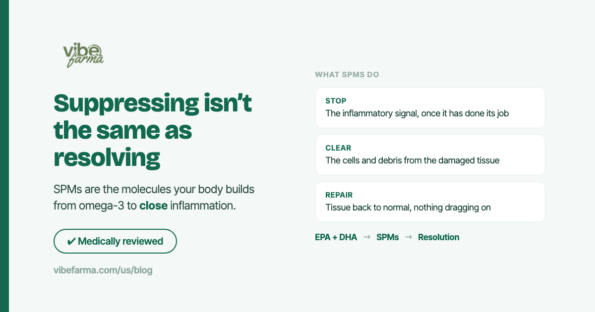
The short version: SPMs — specialized pro-resolving mediators: resolvins, protectins and maresins — are molecules your body builds from omega-3 (EPA and DHA) to resolve inflammation: close it properly and repair the tissue, not just mute the symptom. Without enough omega-3, that closing signal has nothing to be made from.
When something flares up — a knee, a gum, the gut — almost everyone thinks the same thing: stop it. An anti-inflammatory, something that brings the swelling down and takes the pain away.
But there’s a question almost nobody asks: once inflammation has done its job, who switches it off?
For years it was assumed inflammation just faded away on its own, passively, like a bonfire running out of wood. We now know that isn’t what happens. Your body has an active system to resolve inflammation, and it runs on specific molecules: the SPMs.
Contenido
What SPMs are
SPM stands for Specialized Pro-resolving Mediators. They’re molecules your own body makes to close the inflammatory process once the threat has passed.
Within that family there are several groups with names of their own: resolvins, protectins and maresins. Each comes from a different route and covers a different part of the shutdown. They aren’t a drug or a laboratory invention: they’re part of your biology, the same way hormones or neurotransmitters are13.
The simplest way to picture them is this: if inflammation is an alarm that goes off when there’s a problem, SPMs are the switch that turns it off once the problem is dealt with.
Who discovered them
This isn’t a niche theory. The main reason we talk about SPMs today is Dr. Charles Serhan, a researcher at Harvard, who identified these molecules and described how the body moves from “inflame” to “repair”24.
His work overturned an idea that had been settled for decades. Inflammation doesn’t end because it runs out of steam: it ends because the body switches on a program to end it. And that program runs on SPMs.
Suppressing is not the same as resolving
Here’s the distinction that changes everything, and it’s worth getting right.
Suppressing inflammation means disconnecting the alarm. The fire is still there, you just don’t notice it any more. That’s what a classic anti-inflammatory does: it blocks the signal and calms the symptom, but it doesn’t clear the ground.
Resolving is something else. It’s sending in the crew, putting the fire out for real, and repairing what burned. The process gets completed. And that’s exactly what SPMs do, in three steps:
1They stop further recruitment of inflammatory cells once the alarm has done its job.
2They clear the cells and the debris out of the damaged tissue.
3They return the tissue to normal, without leaving background inflammation dragging on.
The difference matters, because inflammation that never fully resolves doesn’t disappear: it stays on a low flame. And that low-grade, unresolved inflammation is being studied as a common thread behind a lot of what we simply put down to “getting older”4.
Where SPMs come from
SPMs don’t appear out of nowhere. Your body builds them from one specific raw material: omega-3 fatty acids, particularly EPA and DHA135.
Put another way: without enough EPA and DHA, your body has the machinery to resolve inflammation but not the material to build the tools. It’s having the factory up and running and no steel.
And here’s the underlying problem. Most people don’t get anywhere near enough EPA and DHA, because we eat little quality oily fish and a lot of omega-6-rich vegetable oil. The result is a body with the capacity to resolve, and no fuel to do it with.
Why any old omega-3 won’t do
At this point a lot of people think: “fine, I’ll take an omega-3 and be done with it.” If only it were that simple.
Not every omega-3 works for this. Three things separate one that actually feeds the process from one that barely moves the needle:
- Real concentration per softgel. Check that the EPA and DHA figures are per softgel, not per three-softgel serving. Some products advertise “1,200 mg” in large type and that number is for several capsules. Small detail, big difference.
- Triglyceride form (TG). Omega-3 in triglyceride form absorbs better than the ethyl ester form, which is cheaper and more common. In a six-month randomised trial, the same dose of EPA and DHA raised the omega-3 index more, and faster, as triglycerides than as ethyl esters6.
- Third-party testing. An independent certification such as IFOS™ is what tells you the oil is what it says it is, without heavy metals and without a high oxidation level.
This subject deserves an article of its own, and it will get one: how to choose a good omega-3 is coming next on this blog.
Two routes to your SPMs
With all that on the table, there are two ways to have SPMs working for you.
The first is to make them yourself, by giving your body a real omega-3 — concentrated, in triglyceride form, third-party tested — so it has raw material to spare. It’s the natural route, and the one we’d recommend as the foundation for almost everyone.
The second is to supply the precursors directly. It’s now possible to deliver 18-HEPE, 17-HDHA and 14-HDHA — the direct precursors your body converts into resolvins, protectins and maresins — instead of depending entirely on how much your own metabolism produces. That’s what we do with SPMs Pro, using the patented Lipinova® emulsion, with the fraction quantified molecule by molecule rather than estimated.
They aren’t competing options. A good omega-3 is the base for almost everyone; the precursors make sense when you want to support the resolution side more specifically.
What this does NOT mean
Important, and we’ll say it plainly:
- This article is science education, not clinical advice and not a treatment guide.
- Omega-3 and SPM precursors are dietary supplements. They are not intended to diagnose, treat, cure or prevent any disease, and they are not a substitute for medical care.
- The biology of SPMs is well described in the literature. The evidence on what supplementing them achieves is still being built, with trials underway. Describing a mechanism is not the same as demonstrating a clinical outcome.
- If you have a diagnosed condition or take medication, talk to your physician before changing anything.
Frequently asked questions
Are SPMs an anti-inflammatory?
Not exactly. An anti-inflammatory suppresses the signal; SPMs help the body complete the process and repair the tissue. They act at different stages.
Can I make SPMs from diet alone?
You can support it by eating quality oily fish, but most people don’t reach the EPA and DHA amounts involved through food alone.
What’s the difference between taking omega-3 and taking SPM precursors?
Omega-3 is the raw material your body uses to build SPMs. The precursors — 18-HEPE, 17-HDHA, 14-HDHA — are one step further along that same pathway.
Is any of this backed by science?
SPM research, led by Dr. Charles Serhan at Harvard, has been running for years and keeps growing: there are more than 2,000 indexed publications on resolvins alone (PubMed, August 2026), and an expert consensus report on the subject was published in 20244. It’s an active field, not a passing trend.
In short
Next time something flares up, it’s worth remembering that your body doesn’t only know how to switch the alarm on: it knows how to switch it off and repair the damage. It just needs the right molecules to do it.
And those molecules depend on something as concrete as the omega-3 you give it.
Vibefarma makes both halves of that chain: Omega 3 Pro, the substrate, and SPMs Pro, with measured 18-HEPE, 17-HDHA and 14-HDHA — formulated to support your body’s own resolution process.*
* These statements have not been evaluated by the Food and Drug Administration. These products are not intended to diagnose, treat, cure, or prevent any disease.
References
- Ferreira I, Falcato F, Bandarra N, Rauter AP. Resolvins, protectins and maresins: DHA-derived specialized pro-resolving mediators, biosynthetic pathways, synthetic approaches and their role in inflammation. Molecules, 2022;27(5):1677.
- Serhan CN, Levy BD. Resolvins in inflammation: emergence of the pro-resolving superfamily of mediators. The Journal of Clinical Investigation, 2018;128(7):2657-2669.
- Chiang N, Serhan CN. Specialized pro-resolving mediator network: an update on production and actions. Essays in Biochemistry, 2020;64(3):443-462.
- Serhan CN, Bäck M, et al. Expert consensus report on lipid mediators: role in resolution of inflammation and muscle preservation. FASEB Journal, 2024;38(10):e23699.
- Serhan CN, et al. E-series resolvin metabolome, biosynthesis and critical role of stereochemistry of specialized pro-resolving mediators (SPMs) in inflammation-resolution […]. Seminars in Immunology, 2022;59:101597.
- Neubronner J, Schuchardt JP, Kressel G, Merkel M, von Schacky C, Hahn A. Enhanced increase of omega-3 index in response to long-term n-3 fatty acid supplementation from triacylglycerides versus ethyl esters. European Journal of Clinical Nutrition, 2011;65(2):247-254.
✔️ Medical review
This article was reviewed by Dr. Jorge Oseguera Anguiano, a physician specializing in functional and pro-resolution medicine, to verify the accuracy of its content.
* These statements have not been evaluated by the Food and Drug Administration. These products are not intended to diagnose, treat, cure, or prevent any disease.

Toni Villar
Founder of Vibefarma. Sixteen years studying the resolution of inflammation — first as a health educator, then alongside the physicians who apply it in clinic. That path led to a meeting with Dr. Charles Serhan at Harvard Medical School, the researcher who discovered SPMs.
He writes here about what the science actually says, with the sources in plain sight. Every article is medically reviewed before it goes out. More about Vibefarma →
Other articles you might find interesting
Resolution of inflammation
What Is Resolution of Inflammation? The Program Your Body Already Has
Resolution of inflammation
What Are SPMs and How They Resolve Inflammation